

A common mistake is thinking that Tamil Nadu’s rent increase rules give owners an automatic yearly hike of a fixed percentage. They do not. The rent increase rules in the state’s tenancy law start with one document: your written tenancy agreement.
This guide explains what the Tamil Nadu Regulation of Rights and Responsibilities of Landlords and Tenants Act, 2017 says about raising rent, how the three-month written notice works, what a tenant can do when an increase feels unfair, and when rent can even come down. It is useful for owners planning a revision and for tenants who have just received one.
Table of Contents
The short answer: what the rent increase rules say
The Act came into force on 22 February 2019 and replaced the old rent control law of 1960. On any rent increase in Tamil Nadu, it keeps things simple and puts the agreement at the centre.
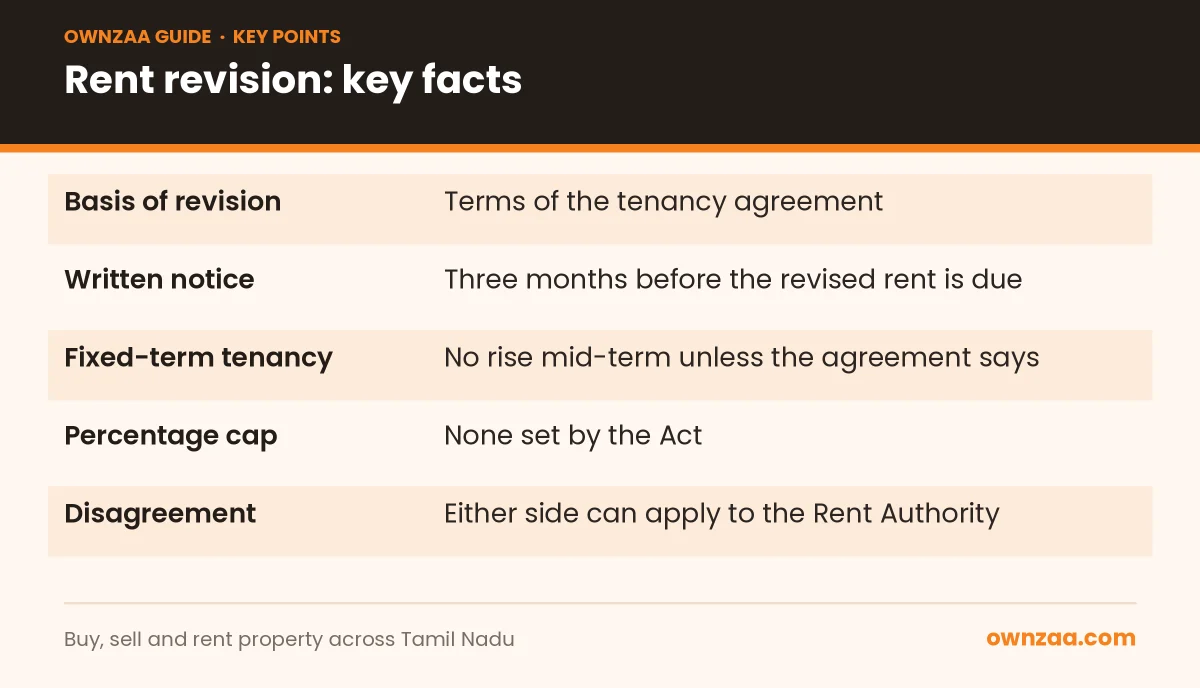
- Rent revision follows the terms set out in the tenancy agreement.
- The Act requires three months’ written notice for a revision agreed in the tenancy agreement.
- If the tenancy is for a fixed term, rent cannot be increased during that term unless the amount of increase, or the method of working it out, is written in the agreement.
- The Act does not set a percentage cap on increases. The amount is whatever the two sides agree.
- Either the owner or the tenant can apply to the Rent Authority to fix or revise the rent.
You can read the wording yourself in the text of the Tamil Nadu Tenancy Act, 2017. For a wider overview of deposits, repairs and eviction, see our guide to your rights under the Tamil Nadu Tenancy Act.
Rent increase rules at a glance
The table below maps common situations to what usually applies. Your own agreement and facts can change the answer, so treat it as a starting point.
| Situation | What usually applies |
|---|---|
| Agreement says rent rises by a set amount or percentage on renewal | Increase as written, with three months’ written notice |
| Fixed-term agreement with no increase clause | No increase during the term |
| Owner wants a bigger rise than the agreement allows | Only with the tenant’s written consent, or a new agreement |
| Owner and tenant cannot agree on revised rent | Either side can apply to the Rent Authority |
| Services or accommodation get worse after rent is fixed | Tenant may claim a reduction |
| Verbal hike with no notice | Weak ground; ask for it in writing |

Why the agreement clause decides almost everything
Under Tamil Nadu’s rent increase rules, rent revision follows the agreement, so a clear clause prevents most disputes. A vague clause invites them. Compare these two ways of writing the same idea.
| Vague clause | Clear clause |
|---|---|
| “Rent will be revised as per market.” | “Rent will increase by 5% on each renewal.” |
| “Owner may increase rent yearly.” | “Rent will increase by Rs 500 after 11 months.” |
| “Increase as mutually decided.” | “Revised rent will be agreed in writing, with three months’ notice.” |
The percentages and amounts above are examples only, not a recommendation. Here is how a clear clause works in practice (illustrative example, round numbers): if the rent is Rs 10,000 and the agreement says 5% on renewal, the new rent is Rs 10,500. Nobody needs to argue, because the method was agreed on day one.
In flats, keep maintenance charges separate from rent in the agreement. Association charges can change on their own, and mixing them into rent makes every change look like a hike. Separate lines keep the rent increase rules in your agreement easy to apply and easy to check.
When you renew an agreement, revisit this clause first. Our guide to rent agreement renewal in Tamil Nadu lists what else to update each year.
How the three-month written notice works
Among all the rent increase rules, the notice requirement is the one people forget most, and it applies to every agreed rent revision. The owner must tell the tenant in writing, well before the new rent is due. The Act requires three months’ written notice for a revision agreed in the tenancy agreement.
Count the three months carefully (illustrative example): if the revised rent is to apply from 1 June, the written notice should reach the tenant by 1 March. Sending it late simply pushes the rent revision date back.
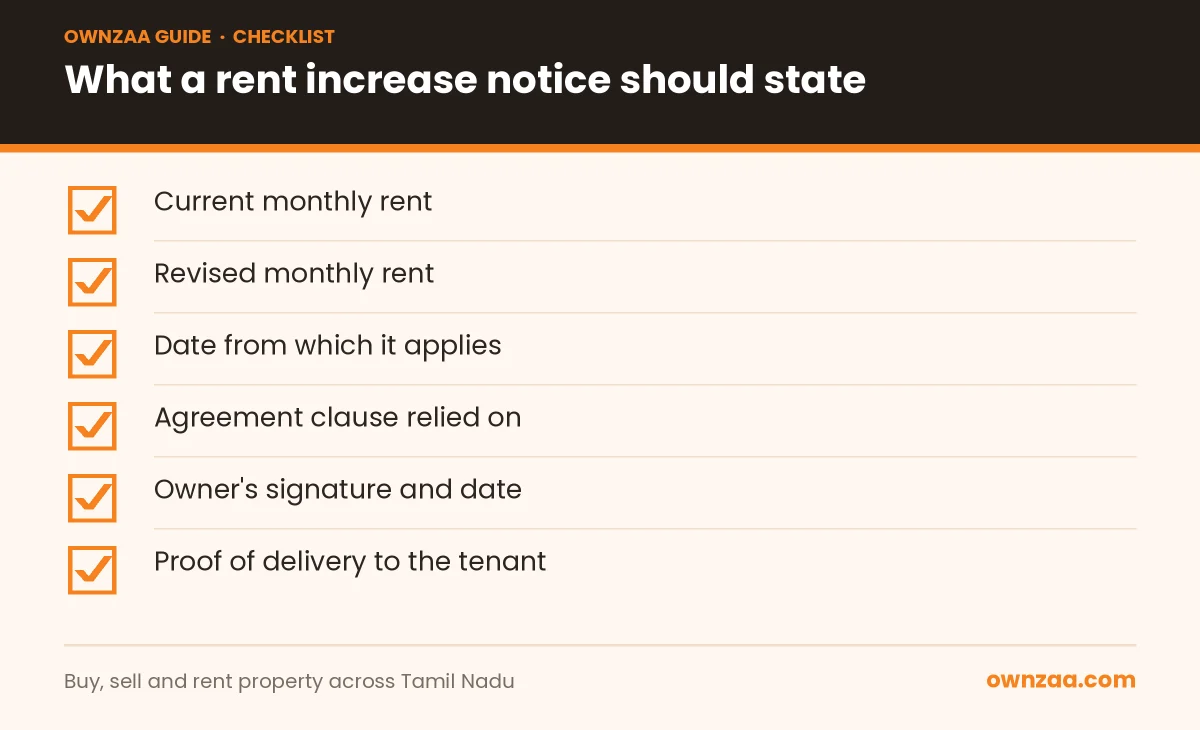
A good notice is short and specific. It should state the current rent, the revised rent, the date from which it applies, and the clause of the agreement it relies on. Signed by the owner and dated, it leaves no doubt.
Deliver it in a way you can prove later. A letter with the tenant’s signed acknowledgement, a registered post receipt, or an email you can show all work. If you use WhatsApp, keep the chat and ask the tenant to reply confirming receipt.
The Act also says something tenants should know. A tenant who receives notice of an intended increase and does not give the owner notice of termination is treated as having accepted the proposed increase. Silence can count as agreement, so respond in writing if you disagree.
Step-by-step: raising rent within the rent increase rules
Owners who follow these steps rarely face a dispute. They also keep good tenants longer, which usually matters more than a small rise.
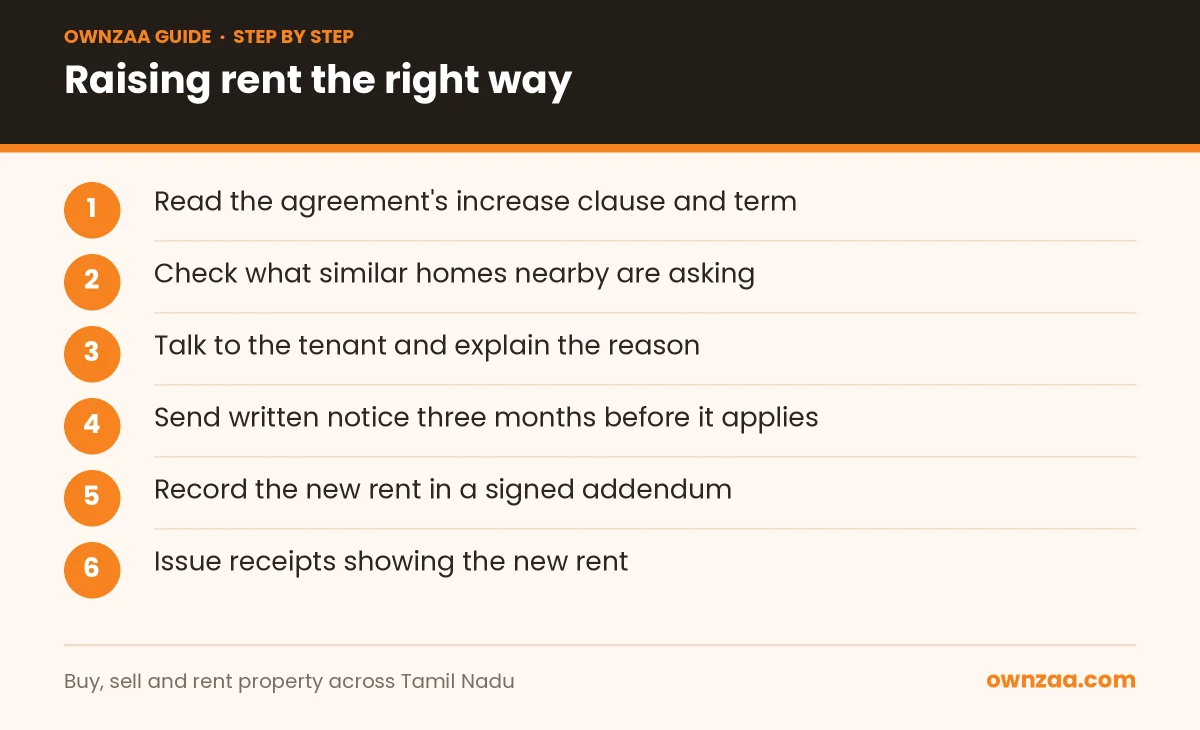
- Read your agreement. Check whether it has an increase clause and whether the term is fixed.
- Check what similar homes nearby are asking, so your figure is realistic.
- Talk to the tenant informally first. Explain the reason, such as higher maintenance or tax.
- Send a written notice at least three months before the revised rent becomes due.
- Record the new rent in a signed addendum or a fresh agreement on renewal.
- Update the Rent Authority records if your agreement is renewed or replaced.
- Issue rent receipts showing the new amount from the effective date.
What tenants can do when an increase feels unfair
The rent increase rules give tenants more room than most people think. Start by reading your agreement. If the proposed rise is more than the clause allows, or arrives mid-term without a clause, you can politely say no in writing and ask the owner to follow the agreement.
If the rise follows the agreement but still feels high, negotiate. Look at current rental listings for similar homes in your area and share two or three comparable examples. Many owners prefer a steady tenant at a fair rent to an empty house for two months.
Whatever you agree, get it in writing and keep paying the current rent on time while you talk. Missing payments during a negotiation weakens your position and can create a separate problem under the Act.
- Offer a longer commitment in return for a smaller increase.
- Ask for a pending repair or a new fitting as part of the deal.
- Suggest spreading the increase, part now and part on the next renewal.
- If you still cannot agree on the rent revision, you can give notice and move, as your agreement allows. Our guide to the notice period to vacate a rented house explains how.
If there is a genuine deadlock, the Act lets either side apply to the Rent Authority to fix or revise the rent and the date from which it applies. Tenancies are registered on the Tamil Nadu tenancy portal; ask the Rent Authority office for your area how to apply. Take legal advice before you go down this route.
When rent can go down, or rise for improvements
Rent increase rules work in both directions. The Act allows a tenant to claim a reduction in rent where, after rent is fixed, the accommodation or housing services decrease or deteriorate. If owner and tenant cannot agree, the tenant can approach the Rent Authority.
Examples could include a lift that stays out of order for long periods, or a car park that is taken away. Document the problem with dates and photos, and write to the owner before asking for any reduction. Whether a change is serious enough depends on the facts, so keep the request reasonable and linked to what was actually lost.
The reverse also happens. An owner may add a facility, such as a new water heater, a covered car park or a second bathroom. If this is meant to change the rent, agree the new amount in writing before the work starts, not after. It avoids the feeling that the tenant was surprised with a bill.
Rent increase and your advance
The rent increase rules and the deposit cap work together. When rent goes up, some owners also ask for a higher advance. For residential houses, the Act caps the security deposit at three months’ rent. Any top-up must stay within that cap and should be agreed in writing, with a receipt for the extra amount.
Tenants should record every payment, including advance top-ups. When you vacate, the advance is refunded after lawful deductions, and clear receipts make that conversation easy.
Older tenancies and oral arrangements
Many long-running tenancies in Tamil Nadu started with a handshake and no paper. The rent may have been raised informally every few years. The Act applies to these tenancies too, but disputes are hard to settle without a written agreement.
The same rent increase rules apply to these older arrangements once they are on paper. If your tenancy has no written agreement, the fix is to make one now, with the current rent and a clear increase clause, and inform the Rent Authority. If the tenancy started before 22 February 2019, ask an advocate how the Act’s transition provisions apply to you. Until then, avoid sudden large hikes, which often end in long and bitter disputes.
Rent increase rules for shops, offices and godowns
The Tamil Nadu Tenancy Act covers non-residential premises too, so the same rent increase rules apply to a shop, office or godown. Rent revision follows the agreement, and the notice and fixed-term points work the same way. What differs is the deposit: for non-residential premises, the security deposit is as agreed between the parties, not capped at three months.
Commercial leases often run longer and carry a fixed escalation, such as a set percentage every year or every few years. Read that clause as carefully as the rent itself. A small yearly rise adds up over a long lease.
GST generally applies to commercial rent, and a rent increase in Tamil Nadu for a shop or office also changes the tax amount. Ask a chartered accountant how it applies to you. Our guide to GST on commercial rent explains the basics.
A sample rent increase notice
Here is a simple format an owner can adapt. It follows the rent increase rules by naming the clause, the new amount and a date at least three months away. Replace the brackets with your details.
To [tenant’s name], [address]. As per clause [number] of our tenancy agreement dated [date], the monthly rent for the above premises will be revised from Rs [current rent] to Rs [new rent] with effect from [date, at least three months from today]. Please acknowledge receipt of this notice. If you wish to discuss it, please contact me before [date]. [Owner’s name, signature and date]
Keep a copy with the tenant’s signed acknowledgement or proof of delivery. Tenants who receive such a notice should reply in writing within a reasonable time, whether they accept, want to negotiate or plan to vacate.
Mistakes to avoid on both sides
Most disputes over a rent increase in Tamil Nadu come from a handful of avoidable errors. Owners and tenants make them equally.
| Mistake | Why it causes trouble |
|---|---|
| Announcing a hike verbally | No proof of notice or date |
| Raising rent mid-term without a clause | The Act does not allow it in a fixed term |
| Cutting water or power to push a rise | Not allowed under the Act |
| Tenant staying silent after notice | Silence can count as acceptance |
| No receipt for the new rent | Confusion over dues and HRA |
| Copying a clause without reading it | Terms nobody understood become binding |
If a disagreement turns into a dispute about staying on, the eviction route is only through the Rent Court. Our guide to how the Rent Court in Tamil Nadu works explains the process.
Frequently asked questions
Do rent increase rules in Tamil Nadu set a maximum percentage?
No. The Tamil Nadu Tenancy Act does not set a percentage cap on rent increases. Revision follows the terms of the tenancy agreement, and the amount is what the owner and tenant agree. That is why a clear increase clause, with a fixed percentage or amount and a timing, matters so much when you sign.
How much notice must an owner give before increasing rent?
The Act requires three months’ written notice for a revision agreed in the tenancy agreement. The notice should state the current rent, the new rent, the date it applies from and the clause it relies on. Keep proof of delivery, such as a signed acknowledgement, a postal receipt or an email.
Can the owner increase rent before my agreement ends?
If your agreement is for a fixed term, the Act says rent cannot be increased during that term unless the agreement itself sets out the amount of increase or the method of calculating it. If there is no such clause, you can decline in writing and ask the owner to wait until renewal.
What happens if I ignore a rent increase notice?
Under the Act, a tenant who receives notice of an intended increase and does not give notice of termination is treated as having accepted the increase. So do not ignore it. If you disagree, reply in writing, explain why, and try to negotiate, or give notice to vacate as your agreement allows.
Can I ask the Rent Authority to decide the rent?
Yes. On an application by the owner or the tenant, the Rent Authority can fix or revise the rent and other charges, and the date from which the revised rent applies. It is best used when talks have failed. Take advice from an advocate before applying, and keep your agreement and payment records ready.
Is a rent increase in Tamil Nadu allowed every 11 months?
Many agreements run for 11 months and are renewed, often with a revised rent. The law does not fix a yearly or 11-month increase. Whether rent rises on renewal, and by how much, depends on your agreement and on what both sides accept. Any rent revision agreed in the agreement still needs three months’ written notice.
Next steps
Owners: read your agreement, check the market, and send a clear written notice for any rent revision three months ahead. If you are setting rent for a new tenancy, our guide on how to fix rent for your house helps you choose a fair starting figure. You can then post your house for rent free on OWNZAA and talk to tenants directly, with no commission.
Tenants: keep your agreement handy, reply to any notice in writing, and compare similar homes before you negotiate. If moving makes more sense, browse owner-direct rentals on OWNZAA. Knowing the rent increase rules keeps the conversation calm on both sides.
This guide is general information, not legal or tax advice. Rules and fees change — confirm current details on the official portals linked above or with a qualified advocate/chartered accountant before you act. Information checked: September 2026.
Image credits: top photo — Chennai Skyline Anna Salai by VtTN, CC BY-SA 3.0, via Wikimedia Commons (resized); in-article photo — Nadar Street in Aravakurichi by Dheenadhoni, CC BY-SA 3.0, via Wikimedia Commons (resized); infographics — OWNZAA.
Ready to find your next property?
Browse verified listings for sale and rent across South India, or post your own property — your first listing is free.