

If you rent a home in Tamil Nadu, or rent one out, the Tamil Nadu Tenancy Act 2017 is the single law that decides most of your rights and duties. Its full name is the Tamil Nadu Regulation of Rights and Responsibilities of Landlords and Tenants Act, 2017. Many online guides skip it or get the important points wrong, especially the limit on the “advance” (the security deposit).
This plain-English guide is written for both tenants and landlords. You will learn what the Act replaced, when it started, the deposit cap, how rent revision works, who handles repairs, the rules on landlord entry and sub-letting, and where to go when a dispute cannot be settled at home. Every point below comes from the Act itself, so you can act on it with confidence and still confirm the details on the official portal.
Read it once slowly. Ten minutes now can save you months of argument later, whether you are signing your first tenancy or letting out a portion house in your street.
Table of Contents
What the Tamil Nadu Tenancy Act 2017 replaced
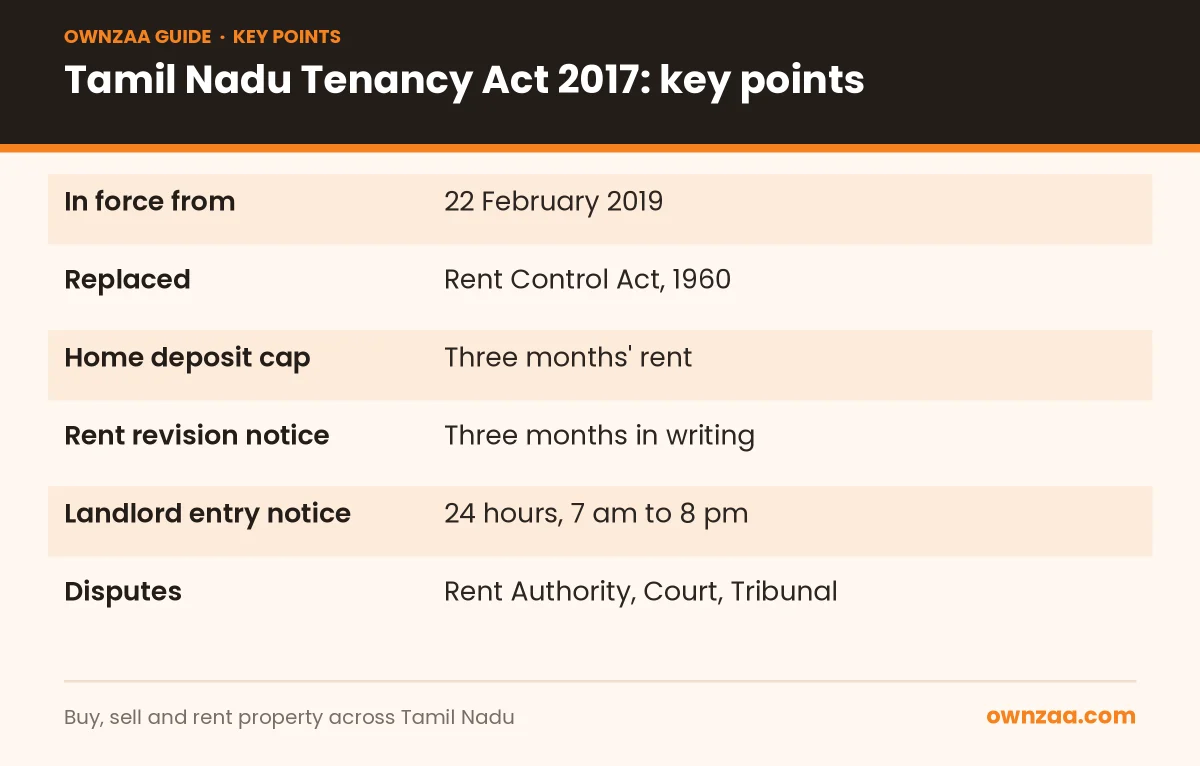
The Tamil Nadu Tenancy Act 2017 came into force on 22 February 2019. It replaced the Tamil Nadu Buildings (Lease and Rent Control) Act, 1960, which had governed rentals in the state for decades. That old law was seen as slow and one-sided, so the state brought in a fresh, balanced framework.
The new law sets out clear rights and duties for both sides and creates its own authorities to settle tenancy disputes. It moves rental matters out of the crowded civil courts and into a dedicated system that is meant to be quicker.
You can read the full text of the Act (PDF) for the exact wording. Keep it handy if you ever need to quote a clause to a landlord or tenant. Most disputes cool down the moment one side shows they know the law.
Who and what the Act covers
The Tamil Nadu Tenancy Act 2017 covers both residential premises, such as houses and flats, and non-residential premises, such as shops, offices and godowns. A few rules, like the deposit cap, differ between the two, so always check which category your property falls under.
It applies to tenancies created after the Act came into force, and to many existing ones once they are put in writing. The law protects tenant rights in Tamil Nadu and landlord rights together, which is the whole point of the reform. Neither side is meant to bully the other.
Some categories, such as government-owned buildings or premises used for certain public purposes, may be treated differently. If your case is unusual, take quick advice before you sign.

Start with a written agreement and the Rent Authority
Under the Tamil Nadu Tenancy Act 2017, every tenancy must be in a written agreement. A handshake deal is no longer enough. The agreement should cover the rent, the advance, the term, the notice period, the rent revision rule and who pays which bills.
Next, the landlord and tenant must inform the Rent Authority about the agreement. This is done online on the official Tamil Nadu tenancy portal. The Rules require this within 90 days of the agreement, and the Rent Authority then issues a tenancy registration number. That number is useful proof if a dispute ever comes up.
This step is separate from registering a lease deed with the Sub-Registrar. We explain both routes, with documents and steps, in our guide on how to register a rent agreement with the TN Rent Authority. If you are still house-hunting, start with our tenant checklist for renting a house in Tamil Nadu and get the paperwork right from day one.
Security deposit limit: three months’ rent
This is the rule most people get wrong. For residential premises, the Tamil Nadu Tenancy Act 2017 caps the security deposit at three months’ rent. For non-residential premises, such as shops and offices, the deposit is whatever both sides agree.
Large advances have long been a local habit, so some owners still ask for six or even ten months. Tenants can politely point to the Act, and landlords avoid future arguments by staying within the cap. A fair deposit also helps you find a good tenant faster.
The deposit must be refunded when the tenant vacates, after lawful deductions such as unpaid rent, unpaid bills or damage beyond normal wear and tear. For a smooth exit, see our guide on getting your rent advance back in Tamil Nadu. Note the meter reading and take photos of the house on moving day.
How rent revision works under the Act
Rent can be revised only as agreed in the tenancy agreement. The Tamil Nadu Tenancy Act 2017 requires three months’ written notice for a revision that the agreement allows. A landlord cannot simply announce a higher rent in the middle of the term.
So the agreement is where both sides set the rules. A clear revision clause usually covers three things:
- When a revision can happen, for example on renewal or once a year.
- How the new rent will be worked out, such as a fixed percentage or mutual discussion.
- That notice of the revision will be given in writing, three months ahead.
Landlords should give notice by letter, email or message and keep a copy. Tenants should ask to see the exact clause before accepting any increase. For the wider picture, read our note on rent increase rules in Tamil Nadu.
Repairs under the Act: who fixes what
The Tamil Nadu Tenancy Act 2017 has a schedule that splits repairs between landlord and tenant, unless your agreement says otherwise. Broadly, the landlord handles structural and major repairs, while the tenant handles minor, day-to-day ones. The table shows the general idea.
| Type of work | Generally handled by | Examples |
|---|---|---|
| Structural repairs | Landlord | Cracks in walls, roof leaks, damaged stairs |
| Major plumbing and wiring | Landlord | Replacing old pipelines or faulty main wiring |
| Minor fittings | Tenant | Tap washers, switches, bulbs, door knobs |
| Day-to-day upkeep | Tenant | Clearing blocked drains, routine cleaning |
| Damage caused by misuse | Tenant | Broken glass or fittings damaged by the occupants |
If a landlord does not carry out a repair that is their job, do not stop paying rent. Put the request in writing and keep a record. If it is still ignored, take advice on raising it with the Rent Authority. Check the exact list in the Act and in your own agreement, because a well-written clause can override the default split.
Landlord entry, privacy and sub-letting
Entry and privacy
During the tenancy, the rented home is the tenant’s private space. The landlord can enter for inspection or repairs, but must give at least 24 hours’ written notice. Entry should be at reasonable hours; the Act mentions 7 am to 8 pm. Tenants, in turn, should allow reasonable access for genuine repairs.
A dated message or email is the simplest way to give this notice, because it also creates a record. Surprise visits, or repeated visits without notice, go against the spirit of the law.
Sub-letting
A tenant can sub-let all or part of the premises only with the landlord’s written consent, usually through a supplementary agreement. Sub-letting without consent is one of the grounds on which a landlord can seek eviction. So if you plan to rent out a spare room, get written consent first and keep it safe.
Eviction only through the Rent Court
Under the Tamil Nadu Tenancy Act 2017, eviction can happen only through the Rent Court, and only on grounds listed in the Act. A landlord cannot throw a tenant out on their own. The main grounds are set out below.
| Ground for eviction | What it means in plain words |
|---|---|
| Rent unpaid for two months | The tenant has not paid rent for two consecutive months |
| Sub-letting without consent | The tenant let someone else in without written permission |
| Misuse or damage | The premises are damaged or used for the wrong purpose |
| Landlord’s bona fide need | The owner genuinely needs the premises, as the Act sets out |
If a tenant stays on after the tenancy ends, the Act allows higher compensation, starting at double the rent, for the overstay. Self-help is not allowed either. A landlord must not cut water or electricity, or lock a tenant out, to force them to leave. Our step-by-step guide on how to evict a tenant through the Rent Court explains the process for owners.
Rent Authority, Rent Court and Rent Tribunal
The Act sets up its own three-level system for tenancy matters, so you know exactly where to go. Each level has a clear job.
- Rent Authority receives information about tenancy agreements and issues registration numbers. It is the first stop for many issues.
- Rent Court decides disputes under the Act, including eviction and deposit cases.
- Rent Tribunal is the appeal level above the Rent Court.
Because this system is meant for tenancy matters only, cases should move faster than in the general civil courts. Keep copies of your agreement, the tenancy registration number, rent receipts and any written notices. Good records win most tenancy disputes long before they reach a hearing.
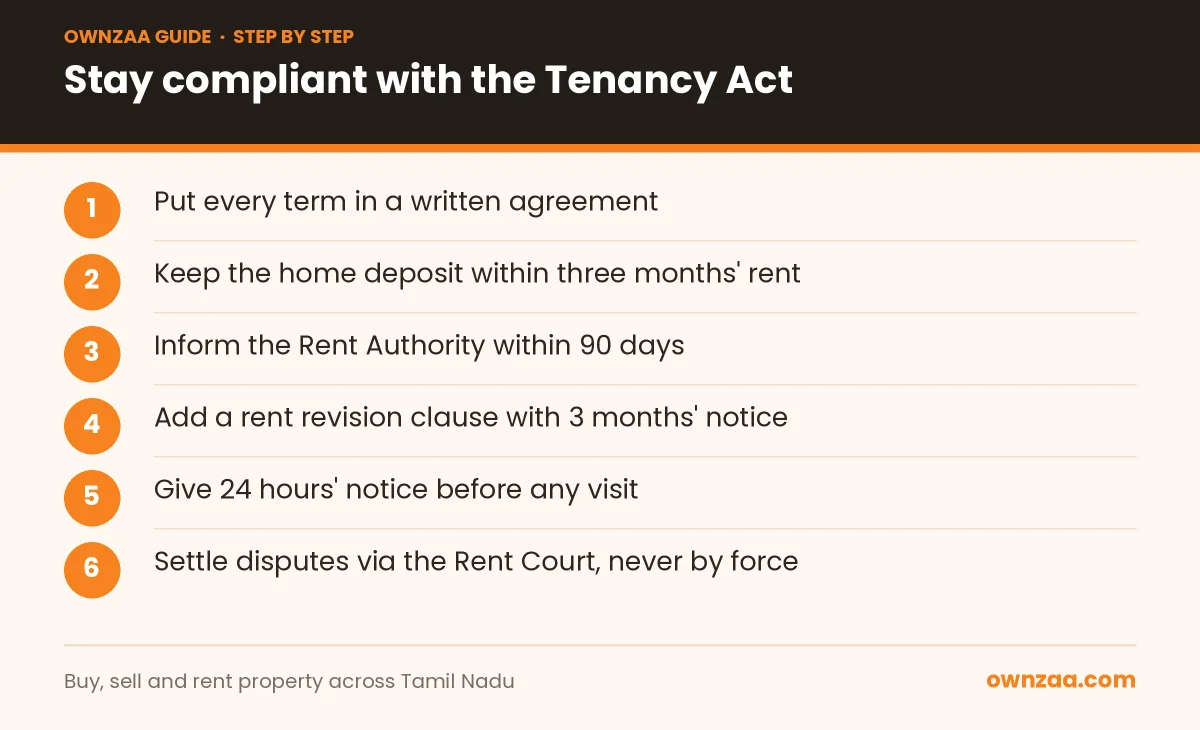
Steps to stay compliant with the Tamil Nadu Tenancy Act 2017
Whether you are a tenant or a landlord, the same simple routine keeps you on the right side of the law. Follow these steps in order for every tenancy.
- Put every term in a written agreement: rent, advance, term, notice and bills.
- Keep the residential deposit within three months’ rent.
- Inform the Rent Authority online within 90 days and save the registration number.
- Add a clear rent revision clause with three months’ notice.
- List who handles which repairs, so nothing is left vague.
- Give 24 hours’ written notice before any inspection or visit.
- Handle any dispute through the Rent Authority and Rent Court, never by force.
Print this list and keep it with your agreement. Both sides doing these seven things is what a smooth tenancy looks like in practice.
Tenant rights and landlord duties at a glance
It helps to see both sides together. The table sums up the balance the Tamil Nadu Tenancy Act 2017 tries to strike between tenant rights and landlord rights. Your own agreement can add detail, but it cannot remove these protections.
| Point | What tenants get | What landlords get |
|---|---|---|
| Deposit | Cap of three months’ rent for homes | Deposit refundable only after lawful deductions |
| Rent | No mid-term surprise increases | Revision as agreed, with three months’ notice |
| Entry | 24 hours’ notice and privacy | Access for genuine repairs and inspection |
| Ending it | No lock-outs or utility cuts | Eviction on listed grounds via the Rent Court |
Read this against your own agreement. If a clause tries to take away a right listed here, ask for it to be changed before you sign.
Common mistakes tenants and landlords make
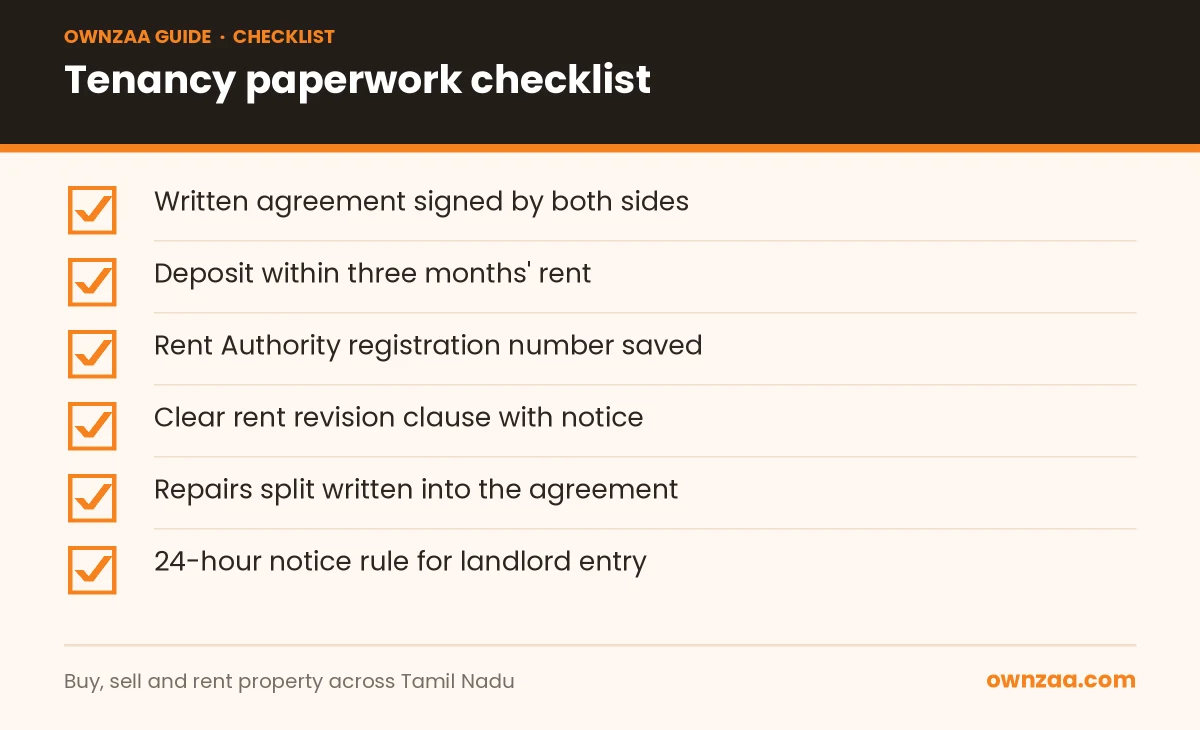
Most tenancy fights start with small, avoidable slips. Watch for these, on both sides:
- Relying on a verbal deal with no written agreement.
- Paying or demanding more than three months’ rent as deposit for a home.
- Skipping the Rent Authority step and losing easy proof of the tenancy.
- Leaving the rent revision rule vague, then arguing about it later.
- Entering the house without 24 hours’ notice.
- Trying to force a tenant out by cutting power or water.
- Sub-letting a room without written consent.
If you recognise any of these in your own tenancy, fix it now. A short written note or a fresh clause is far cheaper than a Rent Court case. For deposits in particular, our guide on getting your advance back lists the deductions a landlord can and cannot make.
Key points of the Act at a glance
Before the questions, here is the whole law in one quick view. Keep it in mind whenever you sign, revise or end a tenancy in the state.
The Tamil Nadu Tenancy Act 2017 is fair to both sides when it is followed properly. It rewards clear paperwork and punishes shortcuts. Owners who list honestly and tenants who pay on time rarely have anything to fear from it.
Frequently asked questions
Is a verbal rental arrangement enough in Tamil Nadu?
No. The Tamil Nadu Tenancy Act 2017 requires every tenancy to be in a written agreement and informed to the Rent Authority. A verbal arrangement leaves both sides without proof of the rent, deposit or notice terms. If you are already in one, put the terms in writing now and complete the Rent Authority step.
Can a landlord ask for more than three months’ advance?
For residential premises, the Act caps the security deposit at three months’ rent. A larger advance may be a local habit, but it goes beyond what the law allows for homes. For shops, offices and other non-residential premises, the deposit is as agreed between the two sides, so read that clause carefully.
How much notice must a landlord give before visiting?
At least 24 hours’ written notice, for inspection or repairs. The visit should be at reasonable hours, and the Act mentions 7 am to 8 pm. A dated letter, email or message you can save is a practical way to give and keep that notice, so both sides have a clear record if there is ever a question.
Can my landlord increase the rent at any time?
No. Rent can be revised only as agreed in the tenancy agreement, and the Act requires three months’ written notice for such a revision. A mid-term increase is not allowed unless the agreement permits it. If you receive a sudden demand, ask the landlord to show the clause in your agreement that allows it.
Can a landlord cut power or water to make a tenant leave?
No. A landlord must not cut water or electricity, or lock a tenant out, to force them to vacate. Eviction is possible only through the Rent Court, on grounds listed in the Act. If it happens, keep evidence and take advice on approaching the Rent Authority quickly.
Does the Act cover shops and offices too?
Yes. The Tamil Nadu Tenancy Act 2017 covers non-residential premises as well, but some rules differ. For example, the three-month deposit cap applies to homes, while commercial deposits are as agreed. Always confirm which category your premises fall under, and check the current position on the official portal.
Next steps
Read your current agreement against the points above, then check that it has been informed to the Rent Authority. If you are looking for a new home, browse houses and flats for rent on OWNZAA and contact owners directly by call or WhatsApp. Landlords can list a rental property for free, and OWNZAA takes no commission on deals. Questions about the site? See our FAQ page.
This guide is general information, not legal or tax advice. Rules and fees change — confirm current details on the official portals linked above or with a qualified advocate/chartered accountant before you act. Information checked: September 2026.
Image credits: top photo — An apartment in OMR by Joel Samuel Raj, CC BY-SA 4.0, via Wikimedia Commons (resized); in-article photo — A typical residential street in the neighbourhood of Triplicane, Chennai. by Challengethelimits, CC BY-SA 3.0, via Wikimedia Commons (resized).
Ready to find your next property?
Browse verified listings for sale and rent across South India, or post your own property — your first listing is free.