
When you sell inherited property in Tamil Nadu, the legal heir certificate is only the first step. Before a buyer or their bank pays, the title must pass clearly from the person who died to the heirs. The official records should name the heirs, dues must be cleared, and every heir must agree to the sale.
This guide is for families who have inherited a house, flat or plot and now want to sell it. It walks through the whole journey, from wills and certificates to heirs living abroad, buyer documents and capital gains basics. Take it step by step, keep an advocate involved, and the sale becomes far less stressful than it first looks.
Table of Contents
What it takes to sell inherited property in Tamil Nadu
Inherited property is different from a normal sale in one way: the seller on paper is no longer alive. So the first job is to move the title from the deceased owner to the living heirs, on record. Only then can the heirs sell as the lawful owners.
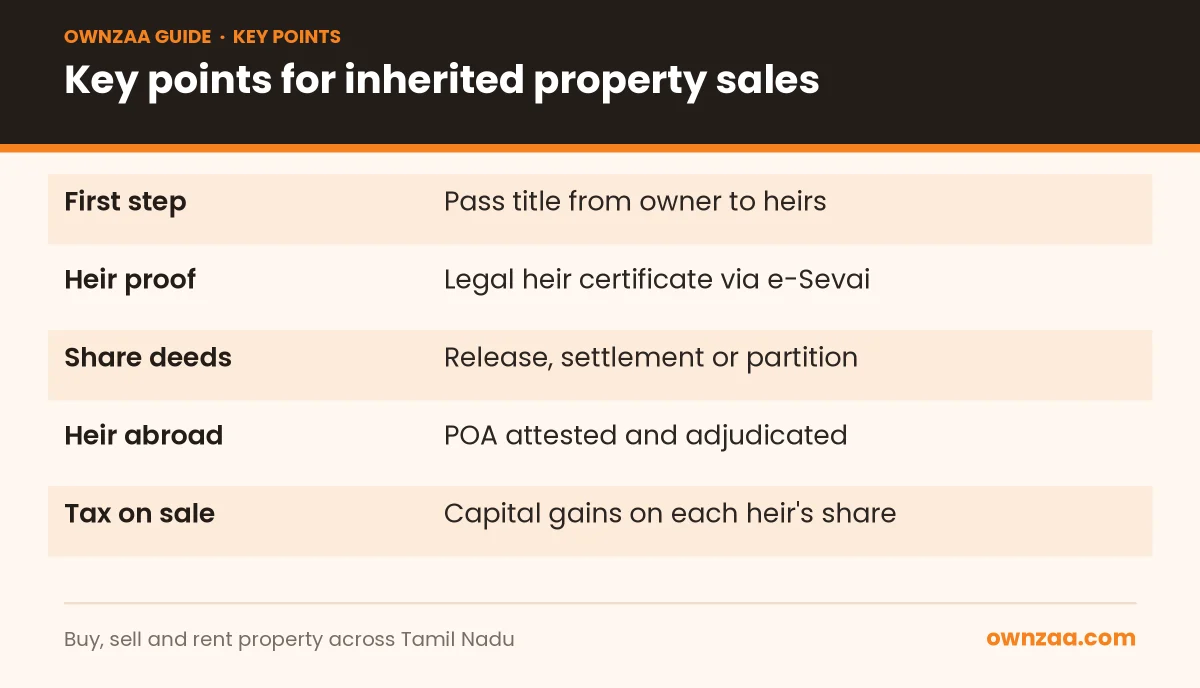
In practice that means three things. First, prove who inherits, through a will or a legal heir certificate. Second, update patta, tax and EB records into the heirs’ names. Third, get every heir to agree and sign. Get these right and the rest of the sale runs like any other.
The reason to sell inherited property in Tamil Nadu carefully is simple: a buyer’s bank will not release a home loan against a shaky title. If the records still name the deceased, or an heir has not consented, the loan file stops. Fixing the paper first is what keeps a good buyer from walking away.
With a will or without one
If there is a will
A will names who gets the property. Keep the original safe, along with the death certificate. A will does not have to be registered, but a buyer’s advocate will look more closely at an unregistered will.
In some cases the court’s confirmation of the will, called probate, may be needed before you can deal with the property. Ask an advocate whether yours needs it. Buyers may also ask the other legal heirs to sign a consent, to avoid disputes later.
If there is no will
Without a will, the property passes to the legal heirs under the succession law that applies to the family. Depending on that law, the spouse, sons, daughters (married or not) and sometimes parents may each have a share. Ask an advocate to map out every heir and their share before you talk to any buyer.

Legal heir certificate versus succession certificate
These two certificates are often mixed up. The table shows the general difference; your advocate can confirm which one your case needs to sell inherited property in Tamil Nadu.
| Certificate | Issued by | Commonly used for |
|---|---|---|
| Legal heir certificate | The Tahsildar (revenue department) | Showing who the legal heirs are, for records such as patta, tax and EB |
| Succession certificate | A civil court | Mainly debts and securities, such as bank deposits or shares |
The legal heir certificate is usually applied for through an e-Sevai centre; check the current process there. Keep the death certificate and every heir’s ID and address proof ready. If heirs disagree, or the family tree is complicated, a court order may be needed instead.
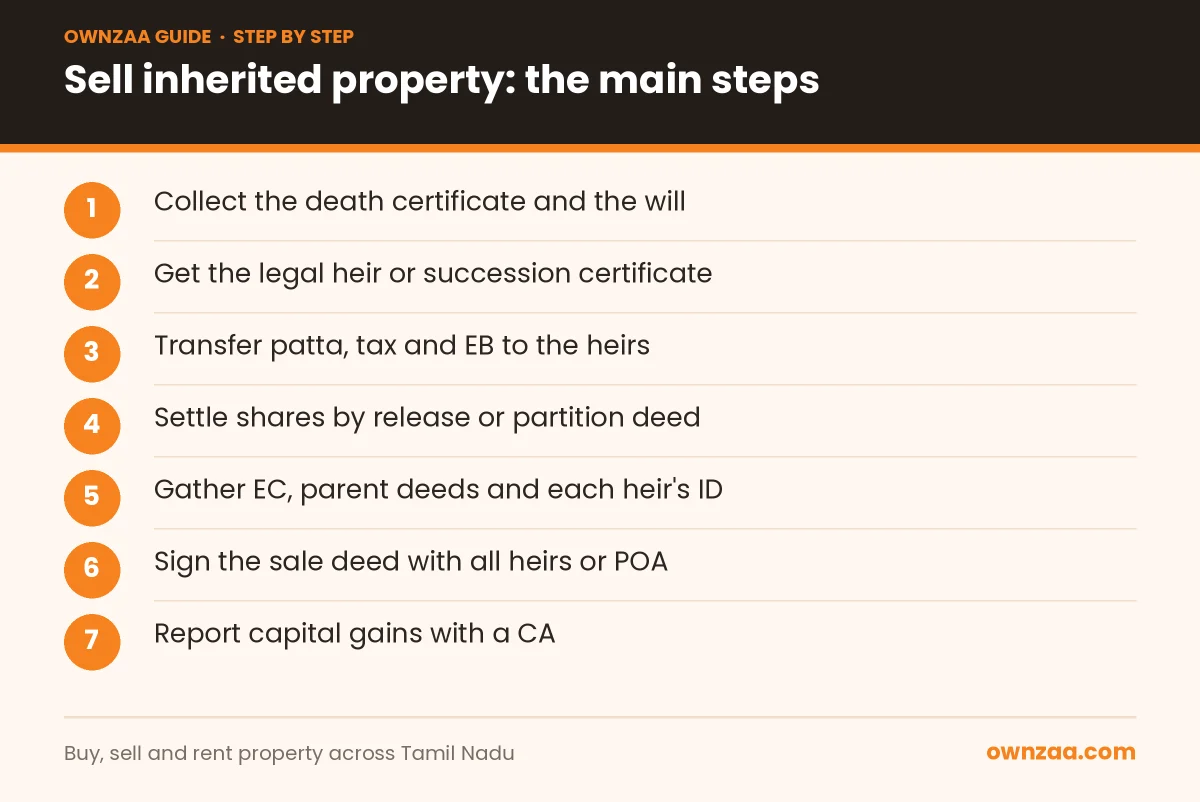
Steps to sell inherited property in Tamil Nadu
Here is the whole process in the order most families follow. Some steps overlap, and an advocate can run several at once, but this is the backbone of the sale.
- Collect the death certificate and the will, if there is one.
- Get the legal heir certificate, or a succession certificate where needed.
- Transfer patta, tax and EB records into the heirs’ names.
- Settle shares among heirs by release, settlement or partition deed, if required.
- Gather the EC, parent documents and each heir’s ID and PAN.
- Sign the sale deed with all heirs present, or through a power of attorney.
- Report capital gains on each heir’s share with a chartered accountant.
Families who sell inherited property in Tamil Nadu in this order rarely hit last-minute surprises at the Sub-Registrar office.
Get patta, tax and EB into the heirs’ names
With the death certificate and legal heir certificate in hand, update the official records. This reassures buyers and helps their bank finish its legal check quickly.
- Patta (land revenue record): apply for transfer to the heirs through the state’s online patta transfer service.
- Property tax: apply to the local body, such as the Greater Chennai Corporation or the respective municipality, corporation or panchayat.
- EB (electricity): apply to the state electricity distribution company, online or at the section office.
Records often go into the joint names of all heirs, which is normal. Clear any arrears first. The steps are similar to those in our guide to patta, tax and EB name transfer, and you can check patta online to confirm the change went through.
Settle shares between the heirs
Heirs often want different things: one wants to keep the house, another wants cash. Agree on paper before you list the property. Common registered documents include the following.
- Release deed: an heir gives up their share in favour of the other co-owners.
- Settlement deed: a family member transfers property to another family member, usually without payment.
- Partition deed: co-owners divide the property so each gets a separate portion.
These deeds are registered at the Sub-Registrar office. Stamp duty and fees depend on the type of deed and sometimes the family relationship. Check current rates on TNREGINET, read our note on settlement deed stamp duty, and confirm with your advocate.
You can also skip these deeds. All heirs can sign the sale deed together as co-sellers and split the money as agreed. Put that split in writing so no one disputes it later. Our guide to joint ownership of property explains how co-owners hold and sell together.
Selling the whole property or only your share
Sometimes the family wants to sell everything. Sometimes just one heir wants to exit and the others want to stay. Both are possible, but they work differently, so decide which one applies before you talk price.
- Whole property: every heir signs the sale deed as a co-seller, or has released their share to those who sign. This is the cleanest way to sell inherited property in Tamil Nadu and what most buyers prefer.
- One heir’s share: that heir can transfer their undivided share by release or sale to the other co-owners, or, rarely, to an outsider. Selling only a share to a stranger is hard, because few buyers want a part interest in a home.
If the family is split, a partition first, then a sale of the agreed portion, usually causes the least friction. An advocate can suggest the order that fits your case.
Get every heir’s consent, including heirs abroad
A buyer’s advocate usually expects every legal heir to sign the sale deed, or to have released their share earlier. One missing signature can stall the deal or trigger a dispute years later.
- Heirs in India sign at the Sub-Registrar office on registration day.
- Heirs abroad can give a power of attorney (POA) to someone they trust. A POA signed abroad must be attested at the Indian embassy or consulate, or apostilled, depending on the country. It must then be adjudicated and stamped in India within the prescribed time before use.
- Minor heirs: selling a minor’s share usually needs court permission, so raise it with your advocate early.
- Heirs who disagree: take legal advice before you accept any advance from a buyer.
For the paperwork behind an overseas signatory, see our guide to the NRI power of attorney in Tamil Nadu.
Documents buyers and their banks ask for
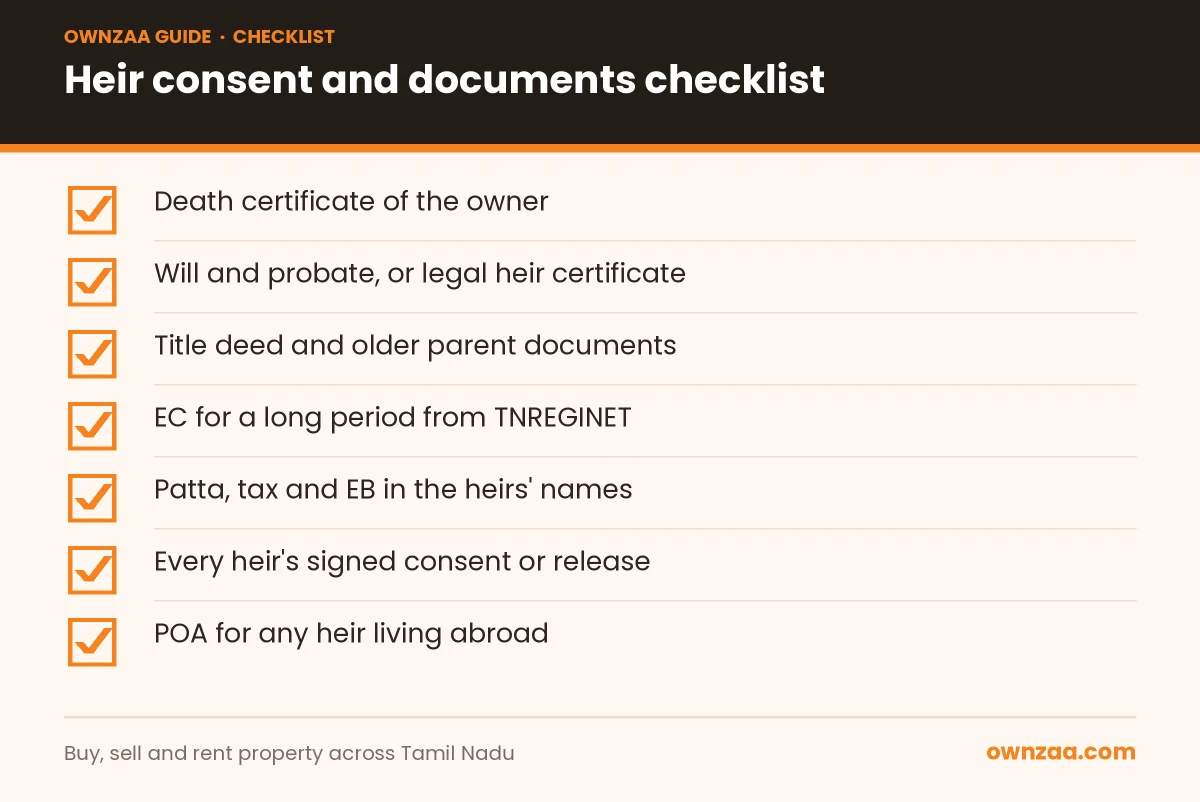
Prepare these before you list, because a buyer taking a home loan will need most of them. A ready file is what lets you sell inherited property in Tamil Nadu without last-minute scrambles, and it builds trust that speeds up the price talk.
| Document | Why it is asked for |
|---|---|
| Death certificate of the owner | Proves the owner has died |
| Will (and probate, if needed) or legal heir certificate | Shows who inherits |
| Owner’s title deed and older parent documents | Shows the chain of ownership |
| EC (Encumbrance Certificate) for a long period | Shows registered loans or other transactions |
| Patta, tax and EB records in the heirs’ names | Shows records match the sellers and dues are paid |
| Release, settlement or partition deeds | Shows how shares were settled |
| POA for any heir abroad | Authorises the attorney to sign |
| ID proof and PAN of every seller | Identity and tax reporting |
| Approved plan or layout approval, where relevant | Shows the building or plot is approved |
| Loan closure letter, if there was a loan | Proves any mortgage is cleared |
Buyers will run the checks in our guide on things to check before buying a property and pull a long Encumbrance Certificate, so prepare for both.
Special cases: agricultural land and old survey numbers
Not every inherited property is a simple house on a single plot. Two situations need extra care before you sell inherited property in Tamil Nadu.
- Whole survey number versus subdivision: when a whole survey number is sold, patta transfer is often automatic. When only part of a survey number passes, the heirs usually have to apply for a subdivision and a fresh patta. Sort this out early.
- Agricultural land: farmland has its own rules on who can buy and on use. Confirm the current position with the revenue office and your advocate, and check the adangal (the village account of land use) matches reality.
Old ancestral holdings sometimes carry survey numbers that were never updated after earlier family divisions. Tracing and correcting them takes time, so begin the moment you decide to sell.
Price it right and avoid guideline-value surprises
Once the title is clean, price the home like any other sale, on its own merits. Compare similar homes nearby rather than guessing from an old family valuation.
Watch the guideline value, the government’s minimum rate for the area. If your sale price is set below the guideline value, the tax department may still work out the gain using the guideline value, which can raise the tax. Keep the two numbers in view when you agree a price, and read our note on guideline value in Tamil Nadu before you commit. Families who sell inherited property in Tamil Nadu at a fair, well-compared price usually attract serious buyers faster.
Tax when you sell inherited property in Tamil Nadu
Inheriting property is not itself taxed as income. Tax comes in when you sell, because the profit is treated as capital gains. A few points matter for inherited homes.
- For inherited property, the law generally lets you count the previous owner’s cost and holding period.
- The holding period decides whether the gain is short-term or long-term, which changes the tax.
- If the sale price is below the guideline value, the tax department may use the guideline value to work out the gain.
- Reinvesting in another home or in specified investments may reduce the tax, subject to conditions.
- Each heir usually pays tax on their own share of the gain.
Rates and rules have changed in recent years, and a new Income-tax Act applies from 1 April 2026. Speak to a chartered accountant (CA) before you fix the price, see our plain guide to capital gains tax on a property sale, and check the Income Tax Department website.
Common mistakes families make
Most delays come from a few avoidable errors. Spotting them early keeps the sale friendly and the family together.
| Mistake | What it leads to | Better approach |
|---|---|---|
| Selling before the title reaches the heirs | Bank rejects the loan, deal falls through | Transfer patta, tax and EB first |
| One heir signing for all | Dispute and possible court case later | Every heir signs or releases their share |
| Ignoring an heir living abroad | Sale stalls near registration | Arrange a valid POA well in advance |
| Pricing below guideline value blindly | Higher capital gains tax | Compare both numbers with a CA |
| No written split of the money | Family arguments after the sale | Put each heir’s share in writing |
When families sell inherited property in Tamil Nadu with clear records and open agreement, the sale rarely turns into a dispute.
Frequently asked questions
Can one heir sell inherited property without the others?
Generally, no. When several heirs inherit together, each is a co-owner, and buyers expect every co-owner to sign the sale deed or to have released their share. Selling without everyone’s consent can lead to disputes and makes it very hard for the buyer to get a bank loan. Talk to an advocate if an heir refuses.
Is a legal heir certificate enough to sell the property?
Usually not on its own. It shows who the heirs are, but buyers also check the parent documents, EC, patta, tax records and every heir’s consent. In some cases probate or a court order may also be needed. Your advocate can tell you exactly what the buyer’s bank is likely to ask for.
The patta is still in my grandfather’s name. What now?
You will need to show every step of succession, from your grandfather to the current heirs. That usually means death certificates and heir documents for each generation. It takes time, so start early and ask an advocate to trace the chain before you look for a buyer.
Do we pay tax when we inherit a property?
Receiving property by inheritance is not itself taxed as income. Tax usually arises only when you sell, as capital gains on each heir’s share. The rules have changed recently, so ask a chartered accountant to work out the likely tax before you agree on a price with a buyer.
How long does it take to sell inherited property in Tamil Nadu?
It depends on how clean the papers are. If the will, heir certificate and records are ready and all heirs agree, the sale moves at a normal pace. If the title still sits in an earlier generation’s name, or an heir is abroad or unwilling, it can take several months. Start the records work early.
What if an heir lives abroad and cannot travel?
They can sign through a power of attorney given to a trusted person in India. The POA must be attested at the Indian embassy or consulate, or apostilled, then adjudicated and stamped in India before use. Arrange it well ahead of registration, because the paperwork and posting take time.
Next steps
Trace the heirs, gather the certificates, and update patta, tax and EB this month. Once the title is clean and every heir agrees, selling is much like any other sale. Our tips to sell your property faster cover the practical side, and our Tamil Nadu market trends guide gives useful context.
When you are ready, list your property free on OWNZAA, or browse homes and plots for sale to compare before you price yours. Buyers contact you directly by call or WhatsApp, OWNZAA takes no commission, and our listing guide shows how to post in a few minutes. Families who sell inherited property in Tamil Nadu with clean records and full consent usually close without drama.
This guide is general information, not legal or tax advice. Rules and fees change — confirm current details on the official portals linked above or with a qualified advocate/chartered accountant before you act. Information checked: September 2026.
Image credits: top photo — Chettinad palatial house by Yashima, CC BY-SA 2.0, via Wikimedia Commons (resized); in-article photo — Chidambaram houses by Flickr user Melanie Molitor, CC BY 2.0, via Wikimedia Commons (resized).
Ready to find your next property?
Browse verified listings for sale and rent across South India, or post your own property — your first listing is free.