
October 1 starts a new half-year for Chennai property tax. If you pay the full amount early in the half-year, the Greater Chennai Corporation has offered a small incentive. If you pay late, interest is added every month.
This guide explains how Chennai property tax works, how to pay it online in a few minutes, and how to change the owner’s name after you buy or inherit a property. It is written for home owners, new buyers and families handling a parent’s property.
Keep your last tax receipt or demand notice next to you as you read. The number printed on it is the key to everything below.
Table of Contents
What Chennai property tax is and who collects it
Property tax is a tax on buildings and land that the local body collects every year. It pays for roads, street lights, storm water drains, garbage collection and other civic work. In the city of Chennai, the local body is the Greater Chennai Corporation (GCC), which covers 200 wards grouped into 15 zones.
Not every address with “Chennai” in it falls under GCC. Areas such as Tambaram and Avadi have their own city corporations, and other suburbs come under municipalities or panchayats. If your property is outside GCC limits, you pay that local body instead, usually through the state’s Urban e-Pay portal. Our guide to Coimbatore Corporation property tax walks through that portal.
The rest of this guide is about GCC property tax: properties inside the Greater Chennai Corporation.
Paying on time matters beyond avoiding interest. Tax receipts in your name help show ownership and possession. Banks ask for them before a home loan or top-up loan. Buyers ask for them before a sale. EB and water offices may also ask for the latest receipt when you transfer a connection.
The two half-years and when Chennai property tax is due
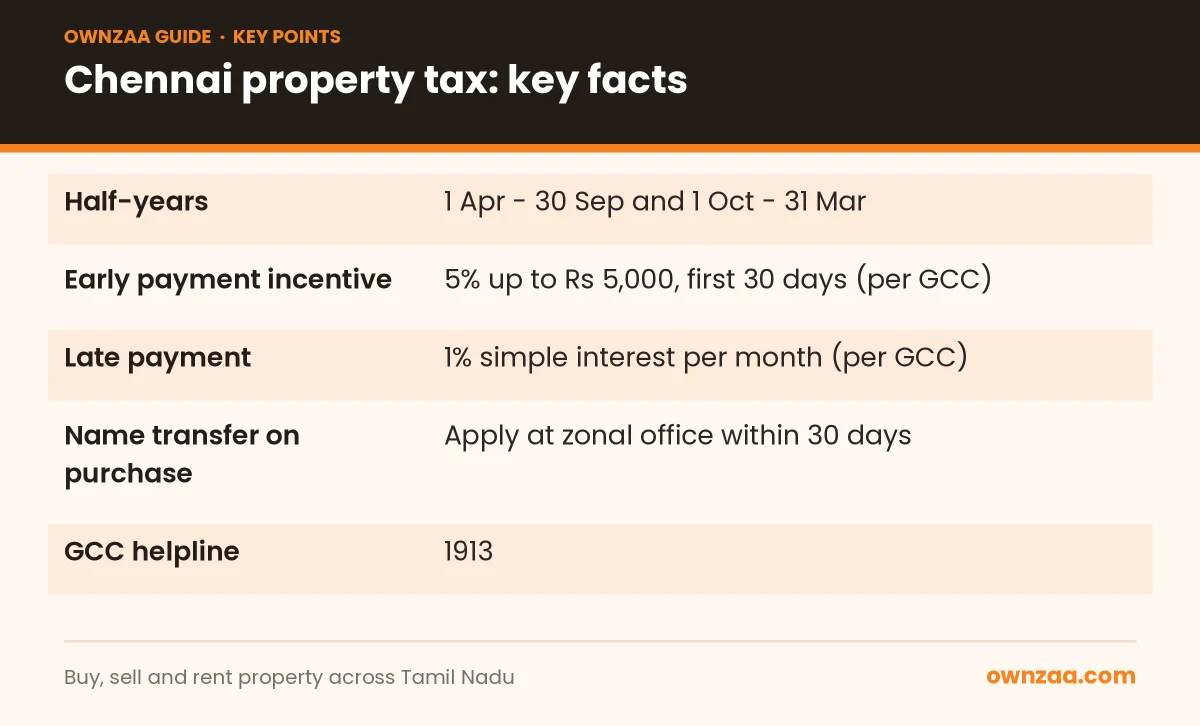
Chennai property tax is charged for each half of the financial year. You receive, or can view online, a demand for each half-year. The GCC website lists these periods:
| Half-year | Period | Early payment window listed by GCC |
|---|---|---|
| First half | 1 April to 30 September | 1 to 30 April |
| Second half | 1 October to 31 March | 1 to 30 October |
Pay each half-year’s tax early in that half-year. GCC states that one percent simple interest per month is charged on tax left unpaid after the deadline. Rules can change, so check the current due date on the GCC website or your demand notice each time.
If you buy a property in the middle of a half-year, agree in writing with the seller who pays the Chennai property tax for that half-year. A common approach is for the seller to clear everything up to the sale date, but it is your agreement that decides. Put it in the sale agreement so nobody argues later.
How Chennai property tax is worked out
You do not need to calculate your own tax, but it helps to know what drives it. Chennai property tax is based on the annual rental value of the building, which is worked out from rates fixed for different streets and areas. The plinth area (built-up area), type of building, its use and its age also matter.
Residential use is taxed at a different rate from commercial use. So if part of your house is used as a shop or office, expect that portion to be assessed differently. Rates are revised from time to time by the corporation under state rules.
If your bill suddenly looks wrong, compare the area and usage on the assessment with the actual building. Errors in plinth area or usage are the most common reason for an unexpectedly high bill, and they can be corrected by applying to your zonal office.
Vacant land inside the corporation is handled separately from buildings. If you own an empty plot in Chennai, ask the zonal office how it is assessed and make sure it has its own assessment in your name.
What you need before you pay Chennai property tax online
Before you start a Chennai property tax online payment, keep these ready:
- Your property tax assessment number or property ID, printed on the last receipt or demand notice
- Zone and division details, if the site asks for them
- A net banking login, debit or credit card, or UPI app
- A mobile number and email ID for the receipt
If you have lost your old receipts, the GCC website has a search option to find your property, and your zonal office can help. New buyers should ask the seller for the latest tax receipt before registration, so the number is on hand from day one.
If the online record shows the wrong details
Sometimes the name, door number or area shown online does not match your property. Do not pay against a record you are unsure of. First confirm with your zonal office that the assessment number is really yours. If it is, pay the tax to avoid interest, and then apply separately to correct the details with supporting documents such as your deed and approved plan.
Chennai property tax online payment: step by step
The screens change from time to time, but the flow on the GCC website is usually like this:
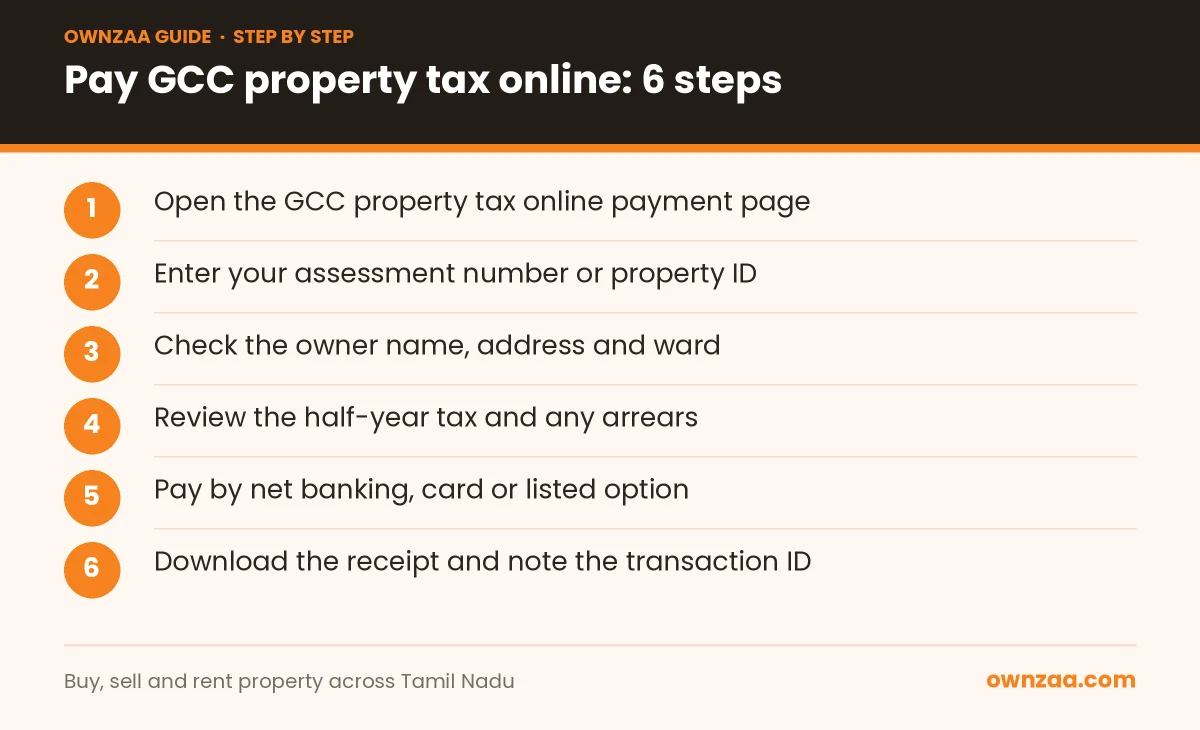
- Open the GCC website and go to the property tax online payment section.
- Enter your assessment number or property ID as shown on your last receipt.
- Check that the owner’s name, address and ward shown match your property.
- Review the demand: current half-year tax and any arrears or interest.
- Choose net banking, card or another listed payment option and pay.
- Download and save the receipt as a PDF, and note the transaction ID.
You can start from the GCC property tax online payment page. GCC states that online payment through its website by net banking or card is without transaction charges.
Other ways to pay GCC property tax
If you prefer not to pay on the website, GCC lists several other channels. They suit older owners or anyone who wants a person to help.
| Payment channel | Good to know |
|---|---|
| Namma Chennai app | GCC’s mobile app, on Android and iPhone |
| E-Seva counters | At zonal and division offices |
| Tax collectors | Hand-held devices with card payment |
| Designated bank branches | Walk-in payment at selected banks |
| BBPS and payment apps | Listed by GCC; save the receipt |
| NEFT or RTGS | Uses details listed on the GCC website |
Be careful with SMS or WhatsApp messages that claim your tax is overdue and give a payment link. Pay only through the GCC website, the Namma Chennai app or the other channels GCC lists. If a message worries you, check your dues directly on the GCC site before paying anything.
Many owners pay on behalf of elderly parents or relatives who live abroad. That is fine. The payment goes against the assessment number, not the payer’s name. Save the receipt and forward a copy to the owner so both of you have a record.
Whichever channel you use, keep the receipt. A receipt with the correct assessment number is your proof of payment if the online record is ever out of date.
Early payment incentive and late interest
GCC’s revenue department page states an incentive of five percent of the property tax, up to Rs 5,000 per assessment, for full payment within the first 30 days of each half-year. It applies only when you pay the full half-year tax in that window.
Illustrative example, round numbers: if your half-year tax is Rs 4,000 and you pay it in full during the incentive window, five percent is Rs 200. If instead you leave it unpaid for three months after the deadline, interest at one percent a month would be about Rs 120. Paying early is the cheaper habit.
After paying, check that your receipt shows the incentive or the net amount you paid. If you paid in full within the window but no incentive appears, raise it with the zonal office with your receipt and transaction ID.
Incentives and interest rules can change with new government orders. Before you rely on the incentive, check the current terms on the GCC revenue department page.
Changing the name after you buy a property
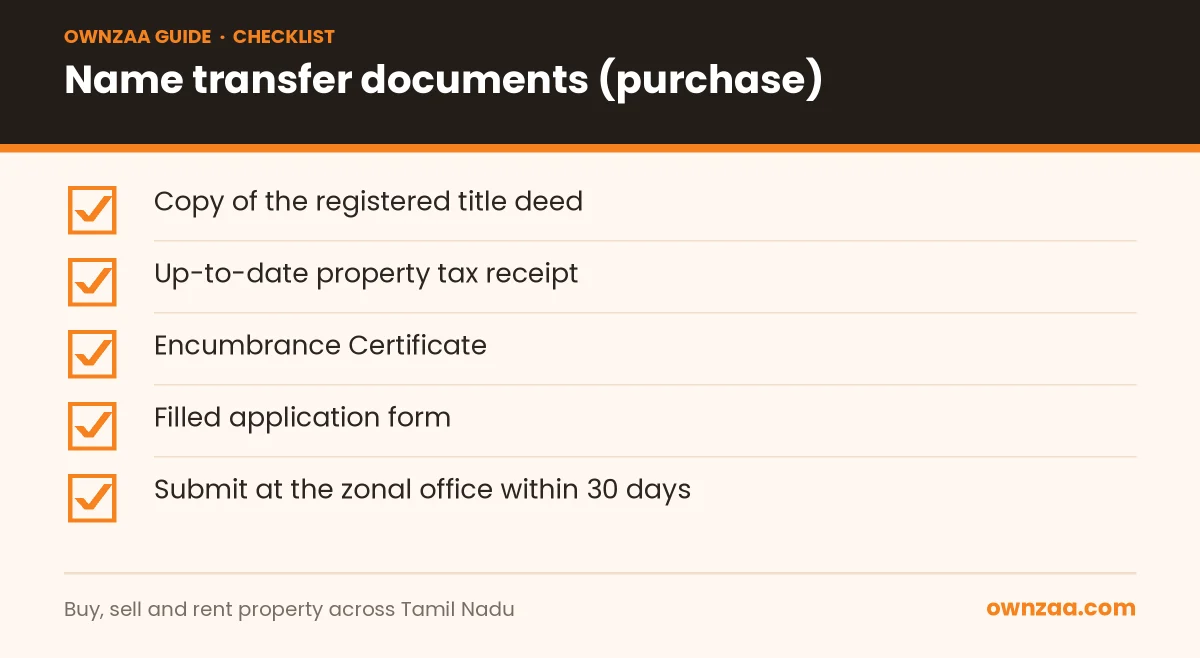
When you buy a property in Chennai, the sale deed makes you the owner. The corporation’s records still show the old owner until you apply for name transfer, also called mutation. GCC’s page says the return for transfer should be submitted at the concerned zonal office within thirty days of the sale.
GCC lists these documents for a transfer after purchase:
- Copy of the registered title deed
- Up-to-date property tax paid receipt
- Encumbrance Certificate
- Filled application form
GCC states that the transfer order can be issued within fifteen days if all documents are submitted. Its website also has a section for paying the name transfer (mutation) fee. Name transfer in the tax record is one of several updates after registration; our checklist on what to do after buying property in Tamil Nadu covers patta, EB and water too.
For a flat, each apartment normally has its own assessment. When you buy a resale flat, transfer that specific assessment to your name. When you buy a new flat from a builder, ask whether the flat has been assessed yet, and whether the builder or the buyer will apply. Get this sorted early so you are not billed for past periods later.
Name transfer for inherited property
If the owner has passed away, the legal heirs apply for transfer. GCC’s page says the legal heir should submit the return at the concerned zonal office within one year, with the death certificate, the legal heir certificate and a filled application form.
A legal heir certificate is issued by the Tahsildar, usually applied for through e-Sevai. Where there are several heirs, the tax may be transferred to all of them jointly, or to one heir with the others’ consent, depending on the family’s arrangement and the documents.
Keep paying Chennai property tax during this period, even before the name changes. Unpaid tax plus interest makes a later sale harder. If the family plans to sell, read our guide on selling inherited property in Tamil Nadu.
New buildings, extensions and corrections
A newly built house or flat must be assessed for tax. GCC’s page says properties should be assessed within thirty days from completion or occupation. Apply to your zonal office with the building approval and completion details.
If you add a floor, extend a room or change part of the building to commercial use, the assessment should be revised. Skipping this may look like a saving, but it can cause trouble when you sell, take a loan or face a later inspection.
In a new apartment building, the builder or the association often coordinates the first assessment for all flats. Ask for your flat’s assessment number as soon as it is issued, and start paying from the correct half-year.
For mistakes in the owner’s name, door number, area or usage, write to the zonal office with supporting documents. Keep a copy of your application with the office seal or acknowledgment number.
Buying or renting? Check the tax first
If you are buying a resale home, ask for the last few Chennai property tax receipts and check the online record yourself. Unpaid tax and interest are a charge on the property, and you do not want to inherit them. Our guide to buying a resale flat in Chennai lists the other papers to collect.
If you are selling, clear all GCC property tax arrears before you list. A buyer’s advocate will ask for the latest receipt, and pending dues can delay the deal or become a point of bargaining.
Tenants usually do not pay GCC property tax. It is the owner’s liability, though some agreements say otherwise. Our explainer on property tax on a rented house covers who pays and how it affects rent.
Common Chennai property tax mistakes
These small slips cost owners money or cause delays later:
- Paying against the wrong assessment number, often a neighbour’s or an old one
- Missing the early payment window by a few days every half-year
- Not transferring the name after purchase or inheritance
- Not updating the assessment after adding a floor or a shop
- Deleting digital receipts instead of saving them in one folder
For complaints about GCC property tax, such as a wrong demand or a payment not reflected, GCC lists its toll-free helpline 1913. Note down the complaint number and follow up with your zonal office if needed.
A simple fix: set two phone reminders a year, on 1 April and 1 October, and save each receipt as a PDF named with the half-year.
Frequently asked questions
When is Chennai property tax due?
GCC charges property tax for two half-years: 1 April to 30 September and 1 October to 31 March. Pay each half-year’s tax early in that half-year. GCC lists the first 30 days of each half-year as the window for its early payment incentive, and charges interest on tax unpaid after the deadline. Check the current dates on the GCC website.
How do I find my assessment number for Chennai property tax online payment?
The assessment number or property ID is printed on your last property tax receipt and on the demand notice. If you have lost them, use the property search on the GCC website with your address details, or ask at your zonal office. New buyers should collect the latest receipt from the seller before registration.
Is there any charge for paying GCC property tax online?
GCC states that online payment through its website by net banking, credit card or debit card is without transaction charges. Third-party apps and other channels may have their own terms, so check before you pay. Always download the receipt and confirm the payment shows against your assessment number.
How long does name transfer take after I buy a property?
GCC asks for the transfer return to be submitted at the zonal office within thirty days of purchase, with the deed copy, tax receipt, EC and application form. It states the transfer order can be issued within fifteen days if all documents are in order. Delays usually come from missing papers.
What happens if I do not pay Chennai property tax on time?
GCC charges one percent simple interest per month on the unpaid amount after the due date. Arrears build up against the property and can delay a sale, loan or name transfer. The corporation can also take recovery action for long-pending dues, so it is best to clear arrears quickly.
Who pays property tax for a rented house in Chennai?
Property tax is the owner’s liability under the corporation’s records. Most rental agreements leave it with the owner, and it is built into the rent. If your agreement asks the tenant to pay it, make sure the receipts still show the owner’s assessment number and keep copies.
Next steps
Find your last receipt, note the assessment number and make this half-year’s Chennai property tax online payment early. If you bought or inherited a property recently, start the name transfer at your zonal office this month.
If you are planning a move, OWNZAA lists homes to buy and rent in Chennai, and you contact owners directly by call or WhatsApp with no commission. Owners can post a property for free as their first listing.
This guide is general information, not legal or tax advice. Rules and fees change — confirm current details on the official portals linked above or with a qualified advocate/chartered accountant before you act. Information checked: September 2026.
Image credits: top photo — Ripon Building panorama 2 by User:PlaneMad, CC BY 2.5, via Wikimedia Commons (resized); in-article photo — Chennai Skyline mt by Ajayy99, CC BY-SA 3.0, via Wikimedia Commons (resized); infographics — OWNZAA.
Ready to find your next property?
Browse verified listings for sale and rent across South India, or post your own property — your first listing is free.