
The real cost of buying a home in Tamil Nadu is more than the price the seller quotes. On top of that price sit stamp duty, the registration fee, legal checks, loan charges, GST on some new flats and a string of small costs that quietly add up. Miss them and your budget falls short on the very day you register.
This guide puts every cost in one place, in plain words, for a first-time buyer. You will learn how the guideline value decides your stamp duty, what changes for new flats and women buyers, what a home loan really costs, and which small charges people forget. You also get a worked example and a fill-in worksheet you can copy today.
Read it before you pay any advance. A clear picture now saves a nasty surprise later, whether you are buying a flat in the city or a plot in your home town.
Table of Contents
What makes up the cost of buying a home in Tamil Nadu
It helps to see the whole picture first. The cost of buying a home in Tamil Nadu is made of one big number, the price, and several smaller ones around it. The table below groups them so nothing slips through.
| Cost group | What it includes | Who usually pays |
|---|---|---|
| Government charges | Stamp duty and the registration fee | Buyer |
| Tax | GST on under-construction flats only | Buyer |
| Loan charges | Processing, legal, technical and insurance fees | Buyer |
| Legal and records | Advocate, EC copies, patta transfer | Buyer |
| Move-in costs | Name transfers, brokerage, moving, repairs | Buyer |
Keep this grouping in mind as you read. Every section below fills in one of these lines with a real figure or an official source you can check. The price and stamp duty take the largest share, but it is the smaller groups that people forget when they plan the cost of buying a home in Tamil Nadu.
Price vs guideline value: what you pay duty on
The guideline value is the minimum value the government fixes for property in each area, street or survey number. You can look it up yourself using the Guideline Value Search on TNREGINET, the Tamil Nadu registration department portal.
For stamp duty, the market value is the higher of two figures: the price in your sale deed and the guideline value. A low declared price will not reduce your duty if the guideline value is higher. If you pay more than the guideline value, duty is worked out on your actual price.
Check the guideline value before you pay any advance (token amount). It helps you budget properly and spot an unusual price. Our note on guideline value in Tamil Nadu shows how to read the search result.
Stamp duty and the registration fee
Stamp duty on a sale deed in Tamil Nadu is 7% of the market value. After the price itself, this is usually the largest single cost of buying a home in Tamil Nadu, and the buyer normally pays it.
The registration fee is charged separately. Its percentage has been revised in recent years and published sources disagree on the current rate, so we are not quoting a figure. Check the current fee table on TNREGINET, or ask at your Sub-Registrar office, before you finalise your budget.
- Ask your advocate or document writer to confirm the exact amounts in writing.
- Keep every payment receipt with your sale deed.
- Budget stamp duty and the registration fee from your own savings, not the loan.
Registration-fee concession for women buyers
A registration-fee concession for women buyers on smaller properties has been announced. If you plan to register the home in a woman’s name, check eligibility on TNREGINET first. The concession relates to the registration fee, so stamp duty still applies.
Do not choose the owner’s name only to save a fee. Ownership affects loans, resale and inheritance, so take your advocate’s advice. Our guide on registration charges for women in Tamil Nadu explains what to check.
New flats: composite value and GST
Composite value registration
New flats from builders work differently. Since December 2023, Tamil Nadu has used “composite value” registration for flats. The land share, or UDS (undivided share of land), and the building are valued together.
Under this system, lower stamp duty applies to flats below certain values. Because the value bands can change, ask the builder for a written break-up of duty and fees, then cross-check it on TNREGINET.
GST: when it applies
GST applies to under-construction flats. It does not apply to ready-to-move or resale homes that already have a completion certificate. That is the general rule, so confirm how it applies to you with the builder or a chartered accountant (CA). Before you book, ask the builder:
- Is GST included in the quoted price or charged extra?
- Which items does it cover, such as car parking or amenities?
- Has the completion certificate been issued yet?
For the wider choice, read our comparison of under-construction versus ready-to-move homes.
The cost of buying a home in Tamil Nadu with a home loan
A loan changes your cash-flow, not the total. Banks usually fund up to 75–90% of the property value, depending on the loan size, under RBI loan-to-value limits. The rest is your down payment. Lenders usually expect stamp duty and registration charges to come from your savings, so confirm this with your bank early.
- Processing fee: charged by most lenders. Compare quotes, as offers vary.
- Legal and technical checks: the bank’s advocate reviews the title and its engineer values the property. A fee may apply.
- Insurance: lenders often ask for property insurance and may offer loan-cover insurance. Ask what is compulsory.
- Mortgage paperwork: some lenders need a mortgage document that attracts its own duty or fee.
RBI rules do not allow banks to charge prepayment penalties on floating-rate home loans to individuals. If you pick a fixed rate, read the prepayment terms carefully. Before you apply, keep your home loan documents ready and check your home loan eligibility.
Legal checks, EC, patta and other small costs
None of these is large alone, but together they deserve a line in your budget.
- An advocate’s title verification and written legal opinion.
- EC (Encumbrance Certificate), which lists registered transactions on the property. You can view it on TNREGINET; certified copies carry a fee.
- Patta (land revenue record) transfer after registration. You can view patta records on the Tamil Nadu e-services land records portal.
- Document writer charges.
- For flats: association transfer charges, corpus fund and maintenance advance.
- Name transfer for property tax, EB (electricity) and water, plus any unpaid arrears.
- TDS: if the price is Rs 50 lakh or more, the buyer must deduct 1% TDS from a resident seller and deposit it; check the current form.
- Brokerage if you use a broker, plus moving and small repairs.
Our guide on things to check before buying a property explains what your advocate should verify, and our EC online guide shows how to pull the encumbrance certificate.
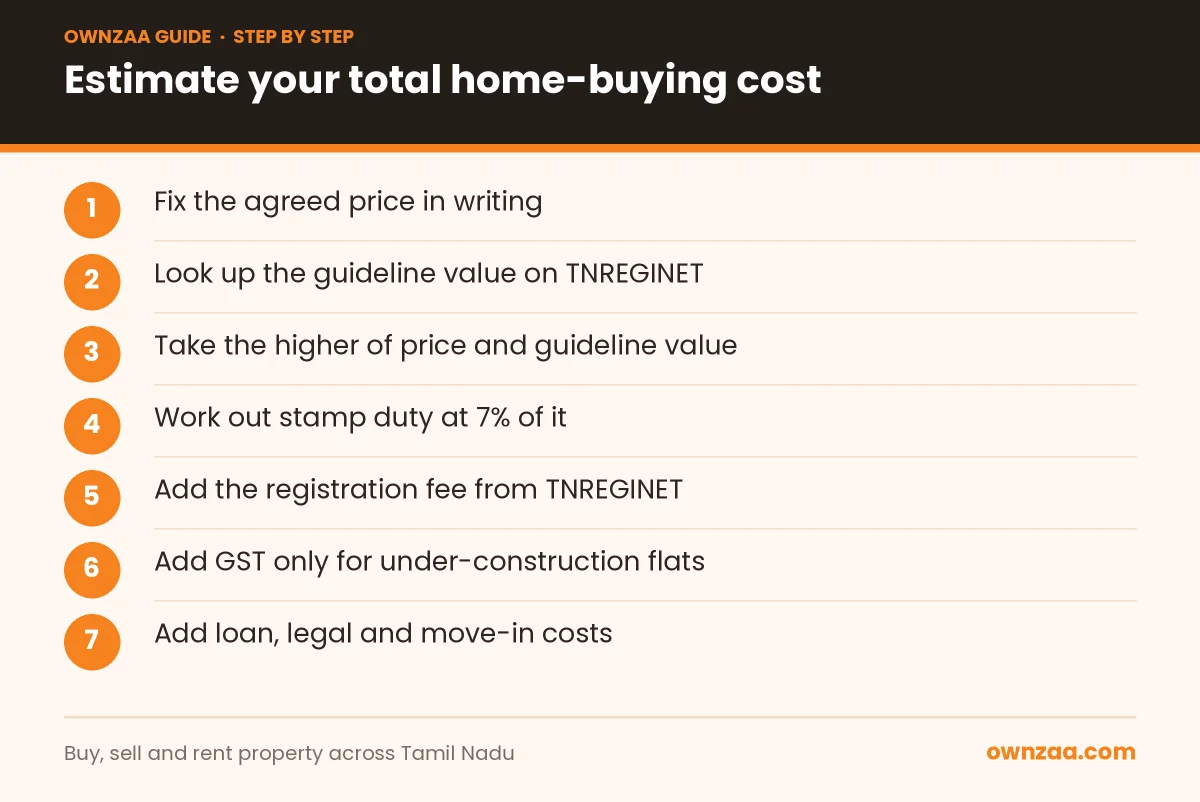
Steps to estimate your total cost before you sign
Work through these steps in order. Each one turns a guess into a figure you can trust.
- Fix the agreed price with the seller in writing.
- Look up the guideline value for the survey number on TNREGINET.
- Take the higher of the two as the market value.
- Work out stamp duty at 7% of that market value.
- Add the registration fee from the current TNREGINET table.
- Add GST only if the flat is under construction.
- Add loan, legal, records and move-in costs from written quotes.
Total these seven lines and keep a small buffer on top. That total is the real cost of buying a home in Tamil Nadu for your deal.
A worked example (illustrative numbers only)
These are round numbers chosen to show the method. They are not real prices, quotes or fee rates.
| Item | Example A | Example B |
|---|---|---|
| Agreed price | Rs 50,00,000 | Rs 40,00,000 |
| Guideline value | Rs 45,00,000 | Rs 45,00,000 |
| Market value (higher of the two) | Rs 50,00,000 | Rs 45,00,000 |
| Stamp duty at 7% | Rs 3,50,000 | Rs 3,15,000 |
| Registration fee | Rs 50,00,000 × [current rate from TNREGINET] | Rs 45,00,000 × [current rate from TNREGINET] |
In Example B, duty is charged on Rs 45 lakh even though the price is Rs 40 lakh. That is the guideline value rule at work.
Now add a loan. If a bank funded 80% of Example A’s price, the loan would be Rs 40 lakh. You would still need Rs 10 lakh, plus duty, fees and smaller costs, from your own funds.
Run your own deal through the same three steps: agreed price, guideline value, then the higher of the two. Once you have the market value, the rest of the cost of buying a home in Tamil Nadu follows in a straight line.
Your cost worksheet
Copy this into a notebook or spreadsheet. Fill each line with a written quote or an official figure, not a guess.
| Cost item | How it is worked out | Your figure (Rs) |
|---|---|---|
| Agreed price | Sale agreement | |
| Stamp duty | 7% of market value | |
| Registration fee | Market value × [current rate from TNREGINET] | |
| GST | Under-construction flats only; confirm with a CA | |
| Loan processing, legal and technical fees | Lender’s written quote | |
| Insurance | Insurer’s or lender’s quote | |
| Advocate, EC copies and document writer | Written quotes plus official fees | |
| Association charges, corpus fund, maintenance advance | Builder’s or association’s letter | |
| Patta, tax, EB and water name transfer | Official fees plus any arrears | |
| Brokerage, moving and repairs | Written terms or your estimate | |
| Total | Add every line |
When you pay each cost of buying a home in Tamil Nadu
Costs do not all fall on one day. Knowing the order helps you keep cash ready at each stage of buying a home in Tamil Nadu, instead of arranging a large lump sum at the last minute.
- At booking or agreement: the token advance, and part of any brokerage.
- Before registration: the advocate’s legal check, EC copies and the balance down payment.
- On registration day: stamp duty, the registration fee and the document writer’s charge.
- Just after registration: the TDS deposit where it applies, and patta transfer.
- On moving in: name transfers for property tax, EB and water, plus moving and repairs.
Spreading the cost of buying a home in Tamil Nadu across these stages makes a big number feel manageable. Keep a little extra aside for the last stage, which people most often underestimate.
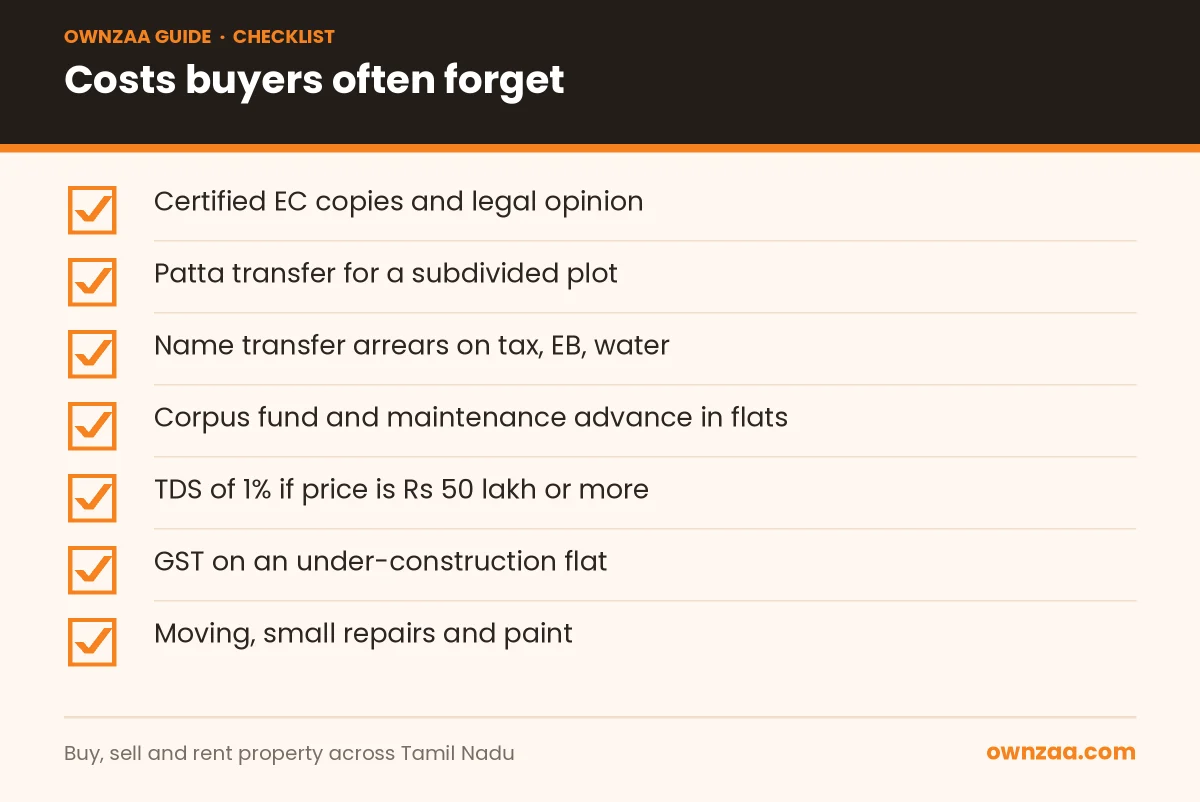
Costs buyers often forget
The big numbers are easy to remember. It is the small, late ones that break a tight budget. Watch for these before you commit:
- Certified EC copies and the advocate’s legal opinion.
- Patta transfer, especially for a subdivided plot.
- Name transfer arrears on property tax, EB and water.
- Corpus fund and maintenance advance in a flat.
- TDS of 1% where the price is Rs 50 lakh or more.
- GST on an under-construction flat, if charged extra.
- Moving, small repairs and a fresh coat of paint.
Add a buffer of a few percent for these. It is far better to finish under budget than to scramble for cash on registration day.
How to lower the cost of buying a home in Tamil Nadu
You cannot avoid stamp duty, but you can trim the rest of the cost of buying a home in Tamil Nadu with a little planning. None of these is a shortcut around the law.
- Compare loan processing fees across two or three banks.
- Check the women-buyer registration concession, if it fits your case.
- Buy a ready home with a completion certificate to avoid GST.
- Skip brokerage by contacting owners directly.
- Clear seller arrears before registration so they are not passed to you.
Read the buy-or-wait picture in our note on buying versus renting in Chennai if you are still deciding.
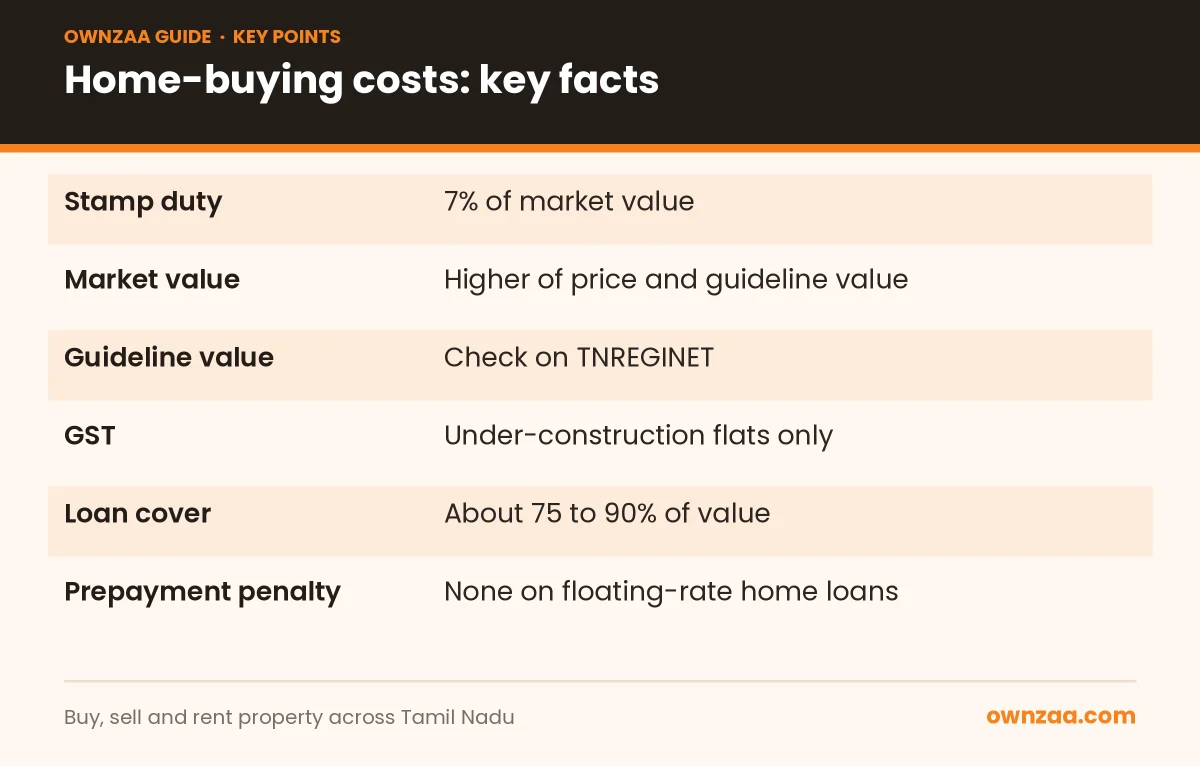
Key cost facts at a glance
Before the questions, here are the anchors to remember. Every figure that can change is tied to an official portal you can check on the day you register.
Two ideas carry most of the weight. First, stamp duty follows the market value, not the price you write down. Second, the loan covers the property, not the government charges. Keep both in mind and the cost of buying a home in Tamil Nadu stops feeling like a guessing game.
Frequently asked questions
Is stamp duty charged on the price or the guideline value?
It is charged on the market value, which is the higher of the price in your sale deed and the government guideline value. So if the guideline value is higher than your agreed price, you pay duty on the guideline value. Check the figure for your survey number on TNREGINET before paying any advance.
What is the current registration fee in Tamil Nadu?
The registration fee percentage has been revised in recent years, and published sources do not agree on the current rate. To avoid budgeting with an outdated figure, check the fee table on TNREGINET or ask your Sub-Registrar office. Your advocate or document writer can also confirm the exact amount in writing.
Can my home loan cover stamp duty and registration charges?
Usually not. Banks generally lend up to 75–90% of the property value, depending on loan size, under RBI limits. Duty, registration charges and most small costs normally come from your savings. Ask your lender for a sanction letter showing exactly what the loan covers before you commit.
Will my bank charge me for repaying the loan early?
RBI rules do not allow banks to charge prepayment penalties on floating-rate home loans to individuals. Fixed-rate loans can carry different terms, so read the sanction letter and loan agreement closely. Even small part-prepayments can reduce the total interest you pay.
Do I have to deduct TDS when I buy a home?
When you buy from a resident seller and the price is Rs 50 lakh or more, you must deduct 1% TDS and deposit it, then hand the seller the certificate. The rules and forms can change, so confirm the current form and process with a chartered accountant before you register.
How much extra should I keep beyond the price?
There is no fixed figure, because rates and small costs vary. A safe habit is to add up stamp duty, the registration fee, loan and legal charges and move-in costs from written quotes, then keep a small buffer on top. That way the true cost of buying a home in Tamil Nadu holds no surprises.
Next steps
Get written quotes for every line in the worksheet and keep a buffer for surprises. When you are ready to shortlist, browse homes and plots for sale or explore property by city, and contact owners directly. OWNZAA takes no commission on deals, so there is no brokerage line from us on your worksheet.
Once the deed is registered, follow our after-registration checklist for patta, tax and EB transfer. For wider context, read about real estate market trends in Tamil Nadu.
This guide is general information, not legal or tax advice. Rules and fees change — confirm current details on the official portals linked above or with a qualified advocate/chartered accountant before you act. Information checked: September 2026.
Image credits: top photo — HiranandaniParksApartments by Daphinevadhera, CC BY-SA 4.0, via Wikimedia Commons (resized); in-article photo — Aurora electronic calculator DT210 05 by Coyau, CC BY-SA 3.0, via Wikimedia Commons (resized).
Ready to find your next property?
Browse verified listings for sale and rent across South India, or post your own property — your first listing is free.