

To register a rent agreement in Tamil Nadu the right way, you need to know that two different offices can be involved, and most confusion starts there. One is the Rent Authority, which you inform online under the state’s tenancy law. The other is the Sub-Registrar, who registers longer lease deeds under the Registration Act. Many guides mix the two up.
This post is written mainly for landlords, but tenants will find it just as useful. You will learn what each registration means, who must do it and by when, which documents to keep ready, the online steps, and how to get your tenancy registration number. Every point is drawn from the tenancy law and the official portals, so you can act with confidence.
Get this right and your tenancy has clear, quick proof from day one. Get it wrong and a simple rent or deposit disagreement becomes much harder to settle. Either way, the effort to register a rent agreement in Tamil Nadu is small next to the trouble it saves later.
Table of Contents
Two registrations, explained
Before you start, separate the two clearly. When people say they want to register a rent agreement in Tamil Nadu, they may mean either step, or both. Here is the difference at a glance.
| Point | Rent Authority (tenancy law) | Sub-Registrar (Registration Act) |
|---|---|---|
| Where | Online, on the Tamil Nadu tenancy portal | Sub-Registrar office, with the TNREGINET portal |
| Which agreements | Every tenancy agreement | Generally longer leases (more than 11 months or above one year) |
| What you get | A tenancy registration number | A registered lease deed |
| Costs | Check the portal for current details | Stamp duty and registration fee, as per current rates |
The key point: the Tamil Nadu Regulation of Rights and Responsibilities of Landlords and Tenants Act, 2017 requires the Rent Authority step for every tenancy. Longer leases are also generally registered with the Sub-Registrar. Confirm what applies to your agreement with the Sub-Registrar or an advocate. For the rights this law gives both sides, read our plain-English guide to the Tamil Nadu Tenancy Act 2017.
When you must register a rent agreement in Tamil Nadu
The Act places the duty on both the landlord and the tenant. In practice, the landlord often starts the online application, because they hold the property documents. Tenants should still follow up and keep a copy of the result, since the registration protects them too.
The Rules require the tenancy to be informed to the Rent Authority within 90 days of the agreement. Do not leave it to the last week. Uploads and approvals can take time, and it is easier to fix a mistake early.
Length does not excuse you. Even a short 11-month agreement must be informed to the Rent Authority. The Sub-Registrar step is the one that depends on the lease term.
There is a simple reason to be prompt. The tenancy registration number is proof that both sides followed the law, and it is far easier to get while the details are fresh and both parties are in touch. Waiting only makes it harder.

Documents to keep ready
The portal lists exactly what it needs, and requirements can change. Keeping these ready usually makes it easier to register a rent agreement in Tamil Nadu without repeated visits to the screen.
| Document or detail | Why it helps |
|---|---|
| Signed tenancy agreement (scanned copy) | The core record of rent, deposit, term and notice |
| ID proof of landlord and tenant | Identifies both parties |
| Proof of ownership, such as the sale deed or property tax receipt | Shows the landlord has the right to let the property |
| Full property address, door number and type (residential or non-residential) | Needed to fill in the form correctly |
| Rent, deposit, start date and term | Must match the signed agreement exactly |
| Mobile numbers and email IDs of both parties | For login and messages from the portal |
| Sub-letting consent (supplementary agreement) | Only if part of the premises is sub-let |
Scan each document clearly and keep the file sizes within the limits the portal shows. A blurry upload is one of the commonest reasons an application is sent back. Naming each file plainly, such as agreement, owner-ID and tenant-ID, saves you from uploading the wrong one under pressure.
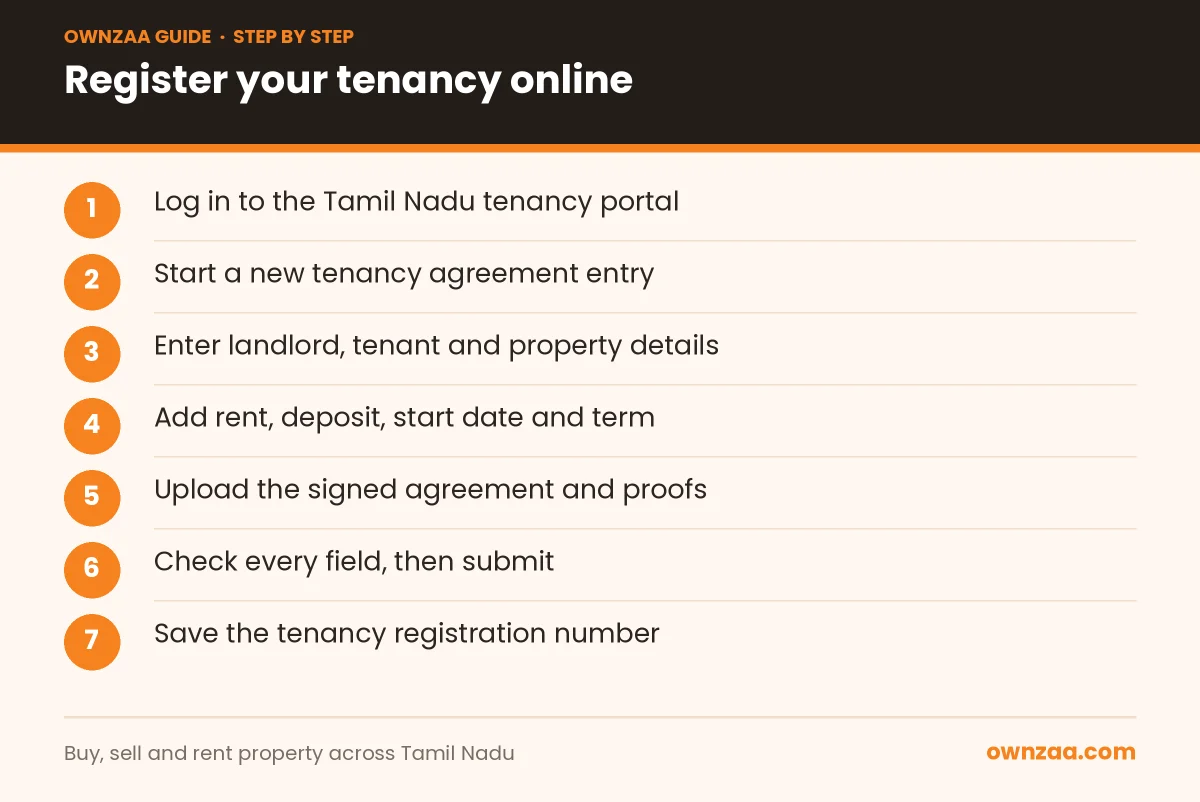
How to register a rent agreement in Tamil Nadu online
The portal’s screens change from time to time. Treat these as general steps and follow the instructions on the official Tamil Nadu tenancy portal.
- Open the portal and create an account or log in.
- Choose the option to inform or register a new tenancy agreement.
- Enter landlord, tenant and property details exactly as they appear in the agreement.
- Enter the rent, deposit, start date, term and notice period.
- Upload the signed agreement and supporting documents in the format asked.
- Check every field, then submit. Save the acknowledgement or reference number.
- Track the status and respond quickly if the Rent Authority asks for corrections.
Fill the form in one sitting if you can, with all documents open in front of you. That habit alone cuts most errors, and it is the simplest way to register a rent agreement in Tamil Nadu without a second attempt.
Getting your tenancy registration number
Once the Rent Authority accepts the details, it issues a tenancy registration number. Download or print the document that shows it, and share a copy with the other party. Keep it with your signed agreement.
This number is your quick proof that the tenancy was informed as the law requires. It helps a great deal if a disagreement about rent, the deposit or notice ever reaches the Rent Court. Treat it like any other important property paper and store a backup on your phone or email.
A quick example of registering a new tenancy
Picture a simple case, with no real names or figures. An owner in Coimbatore lets a portion house to a family on an 11-month agreement. Here is how they register a rent agreement in Tamil Nadu, step by step.
- Both sides sign the written agreement and note the date.
- The owner scans the agreement, both ID proofs and the property tax receipt.
- Within a week, the owner logs in to the tenancy portal and enters every detail from the agreement.
- The owner uploads the files, checks each field and submits.
- The Rent Authority reviews it and issues a tenancy registration number.
- The owner shares a copy with the tenant and files the original with the agreement.
The same routine works for a flat in Chennai or a shop in Salem. Once you have done it once, the second time to register a rent agreement in Tamil Nadu takes only minutes.
Stamp paper and the Sub-Registrar route
Rental agreements in Tamil Nadu are usually printed on non-judicial stamp paper, bought from licensed stamp vendors. The stamp duty on a lease depends on its terms, and rates are revised from time to time. We do not quote amounts here. Check current rates on TNREGINET, the state registration portal, or ask a document writer (a professional who prepares deeds).
Many owners use an 11-month agreement for regular rentals. Longer leases, generally more than 11 months or above one year, are usually registered at the Sub-Registrar office. There, the parties typically appear in person, and stamp duty and a registration fee are paid. Confirm current rules and fees before you plan a long lease.
The two steps are separate, so do not assume one covers the other. If you are unsure, ask an advocate. Lump-sum arrangements raise extra questions, which we cover in our note on lease vs rent in Tamil Nadu.
Rent Authority or Sub-Registrar: which do you need?
Use this simple rule of thumb, then confirm the details for your own case.
- Every tenancy: inform the Rent Authority online. This is not optional.
- Short agreement (about 11 months): the Rent Authority step is usually all that the tenancy law expects; confirm with the office.
- Long lease (above one year): also register the lease deed with the Sub-Registrar, with stamp duty and a fee.
- Sub-letting a part: add a written consent and inform it too.
When in doubt, ask the Sub-Registrar office or an advocate which steps your agreement needs. A ten-minute question now is cheaper than an unregistered lease later. If you want a ready template, see our rental agreement format for Tamil Nadu.
Costs to expect
Costs fall into two buckets, and both can change, so treat these as headings to check rather than fixed figures.
| Cost | Where it applies | How to confirm |
|---|---|---|
| Rent Authority charges | The online tenancy step | Check the tenancy portal |
| Stamp duty on the lease | The agreement itself | Check TNREGINET or a document writer |
| Sub-Registrar registration fee | Longer leases | Ask the Sub-Registrar office |
| Document writer or advocate fee | Drafting and advice | Ask for a written quote |
Budget for all four before you sign, so no cost catches you on the day. Keep every receipt with your agreement. A clear budget also makes the whole process feel routine, because you know what each step costs long before you reach it.
When the tenancy ends
When the tenant moves out, or the agreement ends and is not renewed, inform the Rent Authority on the portal. This closes the record and avoids confusion later. If you renew with a new agreement or changed terms, that agreement should be informed too. Check the portal for the current option to close or renew a tenancy.
Tenants should also settle the deposit, final bills and keys in writing. Our guide on getting your rent advance back covers the move-out steps in order.
Tenants: your side of the registration
Registration is not only the owner’s job. As a tenant, you gain real protection when the tenancy is on record, so take an active part rather than leaving it all to the landlord.
- Ask the owner whether they have informed the Rent Authority.
- Request a copy of the tenancy registration number and save it.
- Check that the rent and deposit on record match what you agreed.
- Follow up before the 90-day window closes if nothing has happened.
If the owner is slow, offer to help gather the documents. Both of you can register a rent agreement in Tamil Nadu together, and both of you benefit from the record if a dispute ever comes up.
Common mistakes to avoid
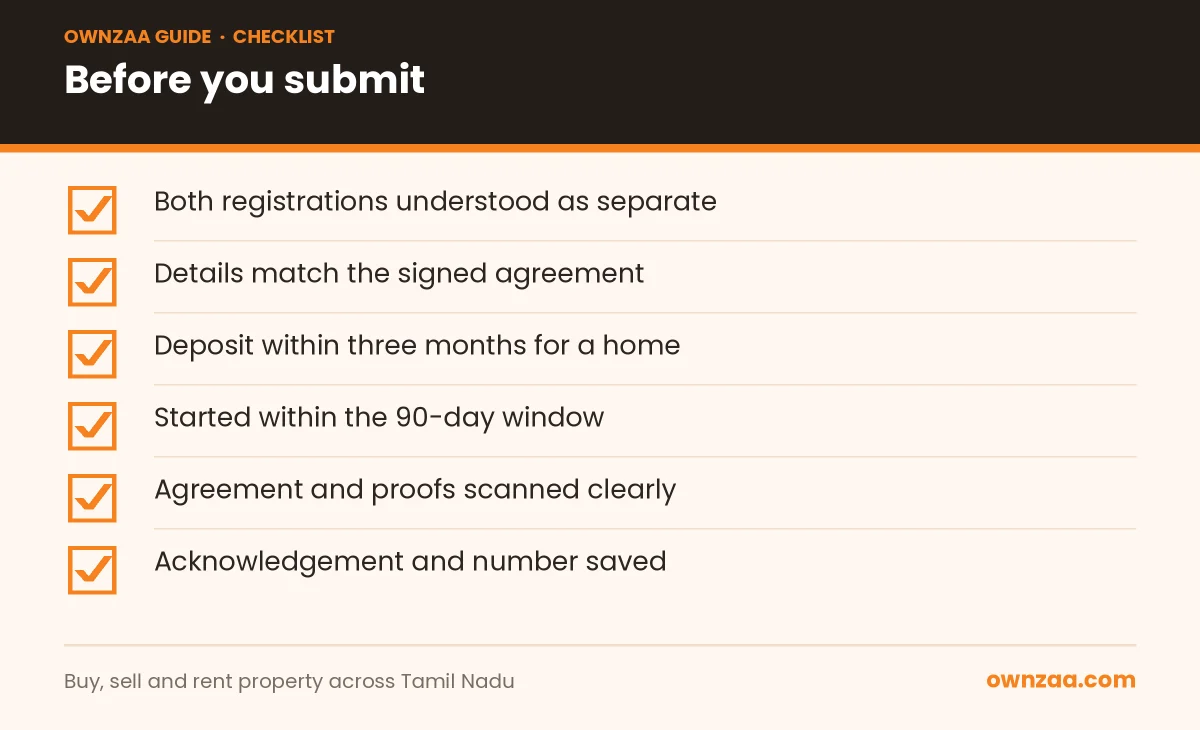
Most problems come from a handful of slips. Check yourself against each one before you submit:
- Assuming one registration covers both. The Rent Authority and the Sub-Registrar are separate.
- Missing the 90-day window. Start as soon as the agreement is signed.
- Details that do not match. Names, rent and deposit on the portal should match the agreement exactly.
- A deposit above the legal limit. For homes, the Act caps the deposit at three months’ rent.
- Not keeping copies. Save the acknowledgement, registration number and signed agreement, and share them.
- Forgetting to close the record. Inform the Rent Authority when the tenancy ends.
None of these is hard to avoid, but each one causes real trouble when it slips through. A short checklist beside your keyboard keeps you honest.
Tips for a smooth registration
A little care makes the whole process painless. These habits help both first-timers and busy landlords who let several homes.
- Sign the agreement and start the online step in the same week.
- Read the agreement and the portal figures side by side before submitting.
- Use the same spelling of names as on the ID proofs.
- Keep one folder, digital or paper, per property.
- Note the 90-day date in your calendar the day you sign.
Owners who let more than one home find it easiest to register a rent agreement in Tamil Nadu when they follow the same routine every time.
Key facts at a glance
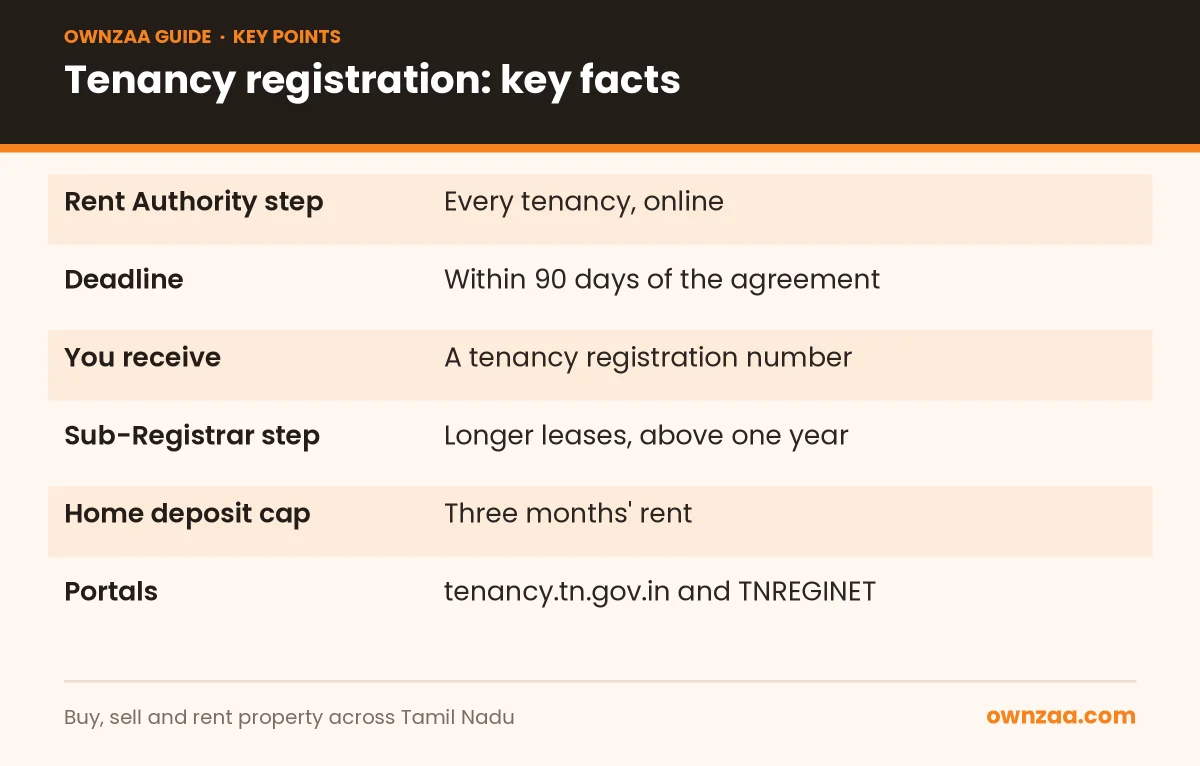
Before the questions, hold on to these anchors. Anything that can change is tied to an official portal you can check on the day.
Two ideas do most of the work. First, every tenancy goes to the Rent Authority online, whatever its length. Second, only longer leases add the Sub-Registrar step. Keep those two apart and it is easy to register a rent agreement in Tamil Nadu correctly the first time.
Frequently asked questions
Is Rent Authority registration the same as Sub-Registrar registration?
No. Informing the Rent Authority is a requirement under the state’s tenancy law, done online, and it gives you a tenancy registration number. Registering a lease deed with the Sub-Registrar happens under the Registration Act and is generally linked to longer leases. They are separate steps, so check which ones apply to your agreement.
What is the deadline to register a rent agreement in Tamil Nadu?
The Rules require the tenancy to be informed to the Rent Authority within 90 days of the agreement. It is best to start as soon as the agreement is signed. That leaves time to fix errors or upload missing documents. Check the official portal for the current procedure, as screens and steps can change.
Who should apply, the landlord or the tenant?
The Act places the duty on both. Landlords often start the application because they hold the ownership documents. Tenants should not assume it has been done. Ask for the tenancy registration number, keep a copy, and follow up if you have not received it well within the 90-day window.
Does an 11-month rental agreement in Chennai need registration?
The tenancy law applies across Tamil Nadu, including Chennai, so every tenancy agreement must be informed to the Rent Authority, whatever its length. Sub-Registrar registration is generally linked to leases longer than 11 months or above one year. Confirm the position for your agreement with the Sub-Registrar or an advocate.
Do shop and office tenancies go through the Rent Authority too?
The Act covers non-residential premises as well, so shop and office tenancies generally need a written agreement informed to the Rent Authority. One difference is the deposit: for non-residential premises it is as agreed between the parties, while homes have a three-month limit. Check the portal for any specific requirements.
What if I never registered my current tenancy?
It is best to put it right now rather than wait. Put the terms in a written agreement if you have not already, then inform the Rent Authority through the portal. Keep the acknowledgement and the tenancy registration number. If the tenancy is long, ask an advocate whether the Sub-Registrar step also applies.
Next steps
Sign a clear written agreement, inform the Rent Authority within the 90-day window, and keep the registration number safe. Owners looking for a tenant can post a rental property on OWNZAA for free and speak to tenants directly. Tenants can browse homes for rent, including properties in Chennai. Before you sign, run through our tenant checklist for Tamil Nadu.
This guide is general information, not legal or tax advice. Rules and fees change — confirm current details on the official portals linked above or with a qualified advocate/chartered accountant before you act. Information checked: September 2026.
Image credits: top photo — Business agreement handshake at coffee shop by rawpixel.com, CC0, via Wikimedia Commons (resized); in-article photo — Laptop Acrobat Model NBD 486C, Type DXh2 – keyboard-8631 by Raimond Spekking, CC BY-SA 4.0, via Wikimedia Commons (resized).
Ready to find your next property?
Browse verified listings for sale and rent across South India, or post your own property — your first listing is free.