
Most rental scams share one move. They ask for money before you have seen the house, met the owner or checked a single document. Once you know that pattern, rental scams become much easier to spot. The same trick turns up for a flat in Chennai, a portion house in Madurai and a room near a college in Coimbatore.
This guide explains how the common tricks work, the warning signs, a seven-step check to do before paying any advance, how to pay safely, and exactly what to do if you have already lost money. There is also a section for owners, because some scams target people who list their homes for rent.
Table of Contents
How rental scams usually work
A scammer needs three things from you: trust, hurry and a transfer. They build trust with nice photos, a friendly voice and sometimes a fake ID. They create hurry by saying other people are interested. Then they ask for a transfer before you can check anything.
The rent is usually attractive, a little below what similar homes nearby ask. That is the hook. People searching in a new city, students, and families moving on transfer are the easiest targets, because they cannot easily visit or ask around.
Nearly all rental scams fall apart when you slow down. Each of these steps has a simple counter. Visit before you pay, meet the real owner, check a document or two, and pay only against a receipt and a signed agreement. The rest of this guide shows how.
Seven common rental scams in Tamil Nadu
These rental scams come up again and again in complaints and news reports. The names and stories change, but the shape stays the same. Most fake rental listings use one of these seven scripts.
1. The owner who is “posted outside the city”
The caller says they are in the army, working abroad or transferred to another state. They cannot show the house, but will courier the keys once you pay the advance and first month’s rent. After you pay the rent advance, the phone goes switched off. No real owner hands over keys by courier to a stranger who has never seen the house.
2. Token advance for a house that is not available
You are asked to pay a small token to “block” the house. The same house may have been promised to several people, or it may already be let. The token is small enough that many victims do not complain, which is exactly why this trick keeps working.
3. Visit fees and registration fees
Someone posing as an agent charges a fee to show you houses or to “register” you. You then see houses that are unavailable, overpriced or not really on offer. Paying for access to listings you cannot verify is a common way to lose money.
4. Copied listings with stolen photos
Photos are copied from a genuine listing or a builder’s brochure and reposted at a lower rent with a different phone number. Fake rental listings like these often appear in several places at once. A reverse image search or a quick visit usually exposes the copy.
5. Double otti or lease on the same house
In an otti (lump-sum lease), you pay a large amount and live without monthly rent. Scammers take otti money from more than one family for the same house, or lease a house that is already mortgaged. Because the sums are large, this is one of the most damaging rental scams in the state. Read our explainer on lease vs rent in Tamil Nadu before you consider an otti.
6. The “owner” who is actually a tenant
The person showing the house has keys, but is a tenant or caretaker, not the owner. They take your advance and disappear, or sub-let without the owner’s consent. Under the tenancy law, sub-letting needs the owner’s written consent.
7. The QR code that takes money instead of sending it
The scammer says they will pay you, perhaps a refund or a deposit, and sends a QR code or a payment request. Scanning it and entering your UPI PIN sends money out of your account. Remember: you never need to enter your PIN to receive money.
Rental scams that target owners
Owners who list a house for rent can be targets too. The most common trick is the “tenant” who cannot visit, agrees to your rent instantly, and then “accidentally” sends more than the agreed amount. They ask you to return the difference. The original payment later turns out to be fake or reversed.
- A “tenant” asks you to scan a QR code so they can pay the advance.
- A caller claiming to be from a company wants to lease the house “for staff” and asks for a processing fee.
- Someone asks for your bank OTP to “verify” your account for a payment.
- A tenant gives a forged ID and later sub-lets the house for short stays.
Meet the tenant in person, check ID, and never share OTPs or scan QR codes to receive money. Our guide to tenant police verification in Tamil Nadu adds another layer of safety for owners.
Warning signs to watch for
Rental scams almost always show at least one of the signs below. One red flag alone does not prove a scam. Two or three together should make you stop and check before sending any money.
| Red flag | What it usually means |
|---|---|
| Advance requested before any visit | The house may not exist or may not be theirs |
| Owner “cannot meet” in person | They are hiding their identity |
| Rent clearly below similar homes nearby | A hook to make you rush |
| Pressure: “three people are waiting” | They want to stop you from checking |
| Payment to a name different from the owner | Money may go to a mule account |
| No written agreement offered | Nothing to hold them to later |
| Request for OTP or UPI PIN | Almost certainly fraud |
A seven-step check before you pay any advance
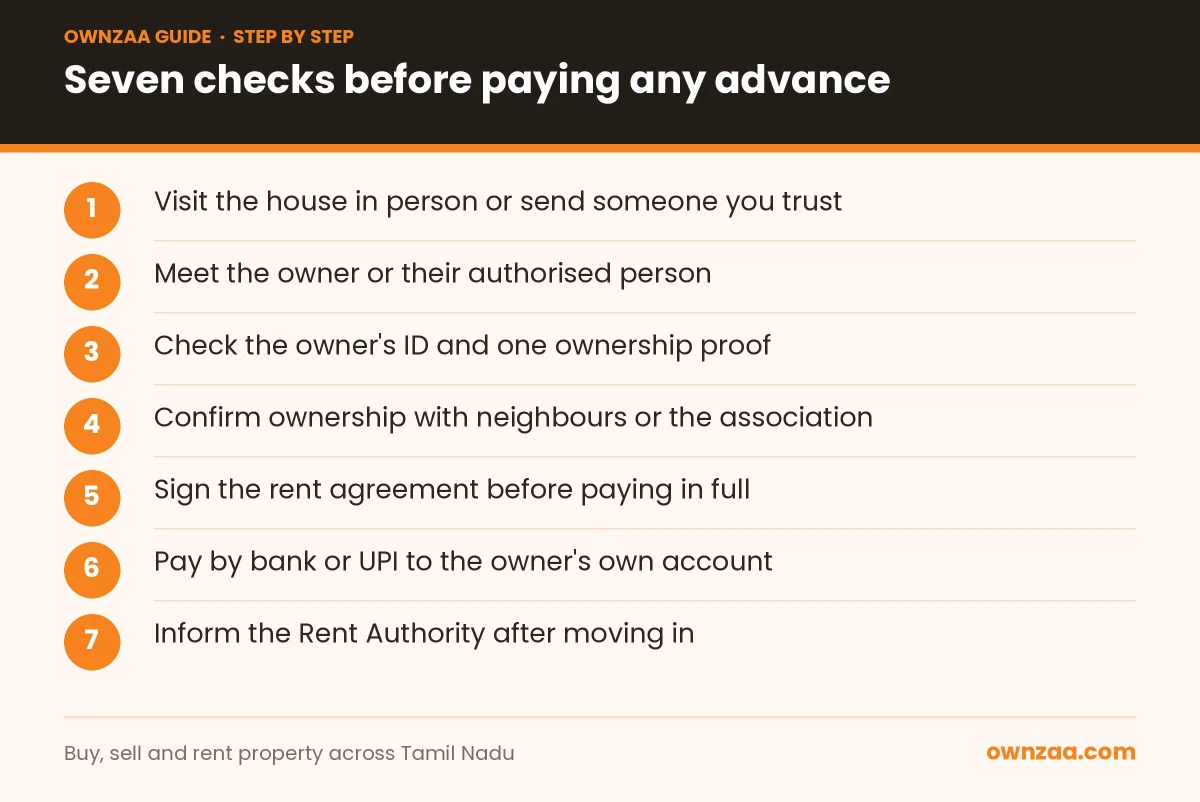
These checks take a day or two, and they defeat nearly all rental scams. That is a small price compared to losing a month’s rent advance or a lakh in otti money. Do them in this order.
- Visit the house in person, or send a trusted friend or relative if you are in another city.
- Meet the owner, or the person authorised by the owner, face to face or on a video call from the house.
- Ask for the owner’s ID and one proof of ownership, such as a property tax receipt, EB card or sale deed copy in the same name.
- Talk to a neighbour, the watchman or the apartment association about who owns the house.
- Read and sign the rent agreement before paying the full advance.
- Pay by bank transfer or UPI to an account in the owner’s name, and collect a signed receipt.
- After moving in, inform the Rent Authority jointly with the owner, as the tenancy law requires.
If the name on the ID, the tax receipt and the bank account all match, you have removed most of the risk. If they do not, ask why before going further. Our full tenant checklist for renting a house in Tamil Nadu covers the rest of the move-in paperwork.
How to pay the advance safely
How you pay matters as much as whom you pay. Cash leaves no trail, and a transfer to the wrong name is hard to recover. Use this simple guide.
| Payment method | Safety tip |
|---|---|
| Bank transfer (NEFT/IMPS) | Account name must match the owner’s ID |
| UPI | Check the name that appears before paying |
| Cheque | Write the owner’s full name; keep a photo |
| Cash | Avoid; if unavoidable, get a signed receipt |
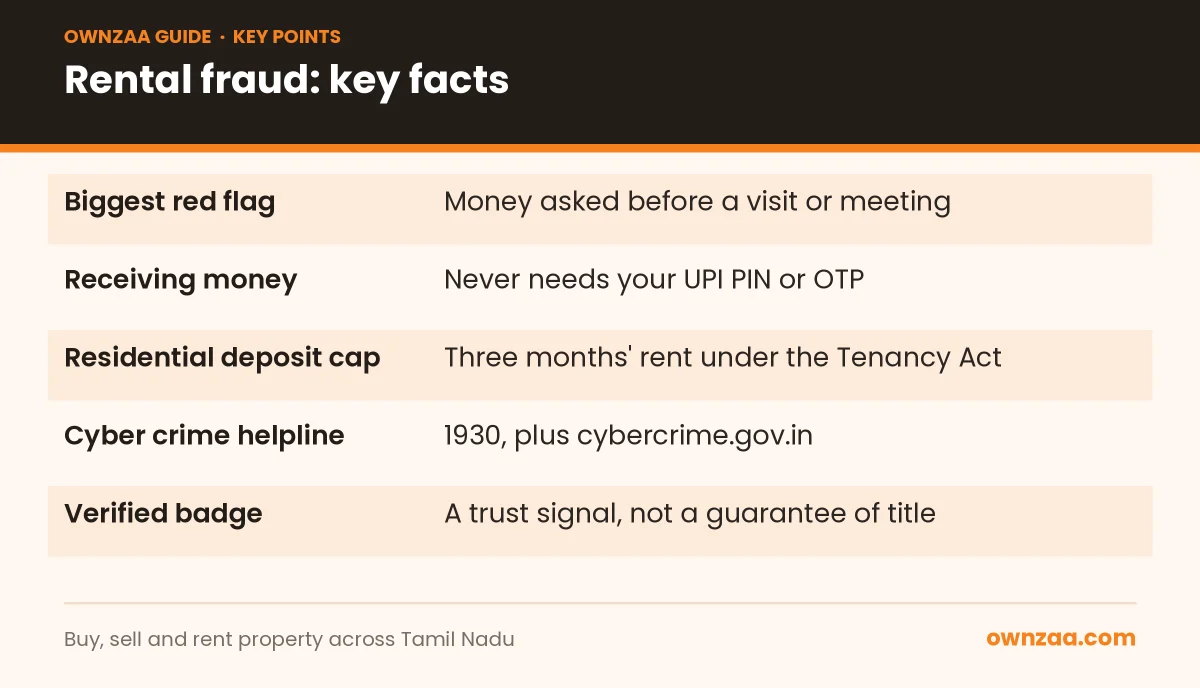
For residential houses, the Tamil Nadu tenancy law caps the security deposit at three months’ rent. A demand for a much bigger rent advance on a normal rental is itself a warning sign. Keep every rent advance receipt safely until you vacate, because you will need them when you ask for your deposit back. Our guide on how to get your rent advance back in Tamil Nadu explains the refund side.
Online listings: what to trust and what to check
Most rental searches now start online, and most listings are genuine. Fake rental listings simply hide among them, and rental scams depend on you not noticing the difference. A few habits help you tell the difference.
- Prefer owner-direct listings, where you speak to the person who owns the house.
- Look for a Verified badge where the platform offers one, but still do your own checks.
- Save screenshots of the listing and chats, with the phone number visible.
- Be wary of listings that move you quickly to a private chat and ask for money there.
- Never pay a “listing fee”, “visit fee” or “key fee” to a stranger.
On OWNZAA, a Verified badge means the owner shared ID and ownership proof that OWNZAA reviewed. It is a useful trust signal, but it is not a guarantee of title. Always visit, meet the owner and sign an agreement before paying.
Students, bachelors and people moving from outside
Students and young professionals often rent in a hurry, just before college opens or a job starts. They may also rent from another city without visiting. That makes them the favourite target of the “posted outside the city” scam.
If you cannot visit, ask a friend, relative or senior student in that city to go for you. If you are still choosing between a PG, a shared flat and a 1BHK, our Chennai PG vs shared flat vs 1BHK comparison helps you decide before you start paying anyone. Do a video call from inside the house, with the owner present. For PGs and hostels, visit and meet the manager before paying, and read the refund terms carefully.
Families moving to Tamil Nadu from other states should also watch out for a rental scam in Chennai or other big cities that uses a local phone number and a Tamil-speaking “caretaker”. A local voice does not make the listing genuine. The same checks apply to a rental scam in Chennai as anywhere else.
What a genuine owner will happily do
A useful way to judge any rental is to ask what a real owner would do. Genuine owners rarely mind reasonable checks, because they also want a reliable tenant. Rental scams, on the other hand, depend on you skipping these steps.
| A genuine owner | A scammer |
|---|---|
| Lets you visit and look around | Finds reasons you cannot visit |
| Shows ID and an ownership document | Sends only a photo of an ID card |
| Signs an agreement before taking the full advance | Wants money first, paperwork “later” |
| Gives receipts and bank details in their name | Asks you to pay a relative or a friend |
| Is fine with neighbours confirming ownership | Asks you not to “disturb” the neighbours |
If the person you are dealing with pushes back on every check, walk away. There will always be another house.
Already paid a scammer? Act within hours
Speed matters with rental scams. The faster you report, the better the chance that the bank can hold the money before it is moved again. Do these things the same day.
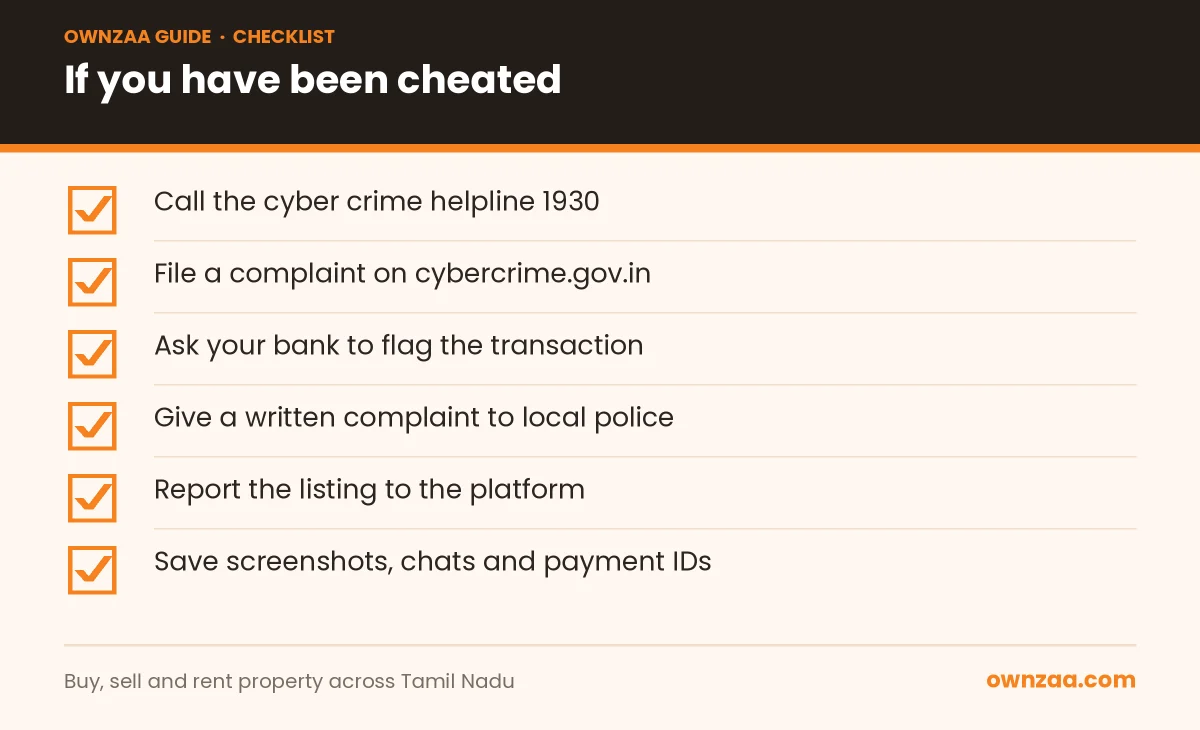
- Call the national cyber crime helpline 1930 and report the transaction.
- File a complaint on the National Cyber Crime Reporting Portal.
- Inform your bank and ask them to flag or hold the transaction.
- Give a written complaint at your local police station and keep the acknowledgement.
- Report the listing and the number to the website or app where you found it.
- Save everything: screenshots, chats, call logs, payment references and the listing link.
Do not pay anyone who promises to “recover” your money for a fee. That is often a second scam aimed at people who have just been cheated.
Protecting yourself after you move in
Rental scams do not stop at the gate. Once you live in a rented house, keep your tenancy paperwork in order. It protects you if a dispute or a fraud comes up later.
Make sure the agreement is informed to the Rent Authority on the Tamil Nadu tenancy portal, which the Rules require within 90 days. Pay rent by bank or UPI, not cash, so you always have proof. If someone other than the owner starts collecting rent, ask the owner directly before paying.
If you are an owner, check the house now and then with proper written notice, which the Act requires at least 24 hours in advance. It is the simplest way to spot illegal sub-letting early.
Frequently asked questions
What are the most common rental scams in Tamil Nadu?
The most common ones are the owner who cannot meet and asks for an advance to courier keys, token advances for houses that are not available, visit or registration fees charged by fake agents, copied listings with stolen photos, double otti on one house, and QR codes that take money instead of sending it.
How can I verify that the person is the real owner?
Ask for their ID and one ownership proof in the same name, such as a property tax receipt, an EB card or a copy of the sale deed. Then confirm with a neighbour, the watchman or the apartment association. Finally, pay only to a bank account in that same name, against a signed receipt.
Is it safe to pay a token advance online?
Only after you have visited the house, met the owner and checked a document. Pay by bank transfer or UPI to an account in the owner’s name, and ask for a receipt or at least a written confirmation of what the token covers and when it is refundable. Never pay a token to hold a house you have not seen.
What should I do if I lost money in a rental scam in Chennai?
Call 1930 immediately and file a complaint on the National Cyber Crime Reporting Portal. Inform your bank the same day so it can try to hold the money. Then give a written complaint at your local police station, report the listing to the platform, and keep all screenshots and payment references safely.
Do fake rental listings appear on genuine websites?
Yes, scammers sometimes post on genuine platforms and then move the conversation to a private chat. That is why every rental, even on a trusted site, needs your own checks: a visit, a meeting with the owner, a matching document and payment only against a signed agreement and receipt.
Can rental scams happen with a known broker?
Yes, though it is less common. A broker may show a house without the owner’s consent, or collect an advance and pass on only part of it. Meet the owner yourself before paying the full advance, pay the owner directly where possible, and get a receipt that names what the broker’s fee covers.
Next steps
Before your next house visit, save the seven-step check on your phone and share it with anyone house hunting with you. Most rental scams fail the moment you insist on a visit, a document and a receipt. If you are buying rather than renting, the risks are different and larger; our guide to property fraud in Tamil Nadu covers fake documents and double sales.
When you are ready to search, browse owner-direct homes for rent on OWNZAA and look for listings with the Verified badge. Call or WhatsApp the owner directly, ask your questions, and visit before paying anything. OWNZAA takes no commission, so there is never a reason to pay a stranger a fee just to see a house.
This guide is general information, not legal or tax advice. Rules and fees change — confirm current details on the official portals linked above or with a qualified advocate/chartered accountant before you act. Information checked: September 2026.
Image credits: top photo — Chennai thomas 3 by Ajayy99, CC BY-SA 3.0, via Wikimedia Commons (resized); in-article photo — Houses in Tamil Nadu by Superbmust, CC BY-SA 3.0, via Wikimedia Commons (resized); infographics — OWNZAA.
Ready to find your next property?
Browse verified listings for sale and rent across South India, or post your own property — your first listing is free.