
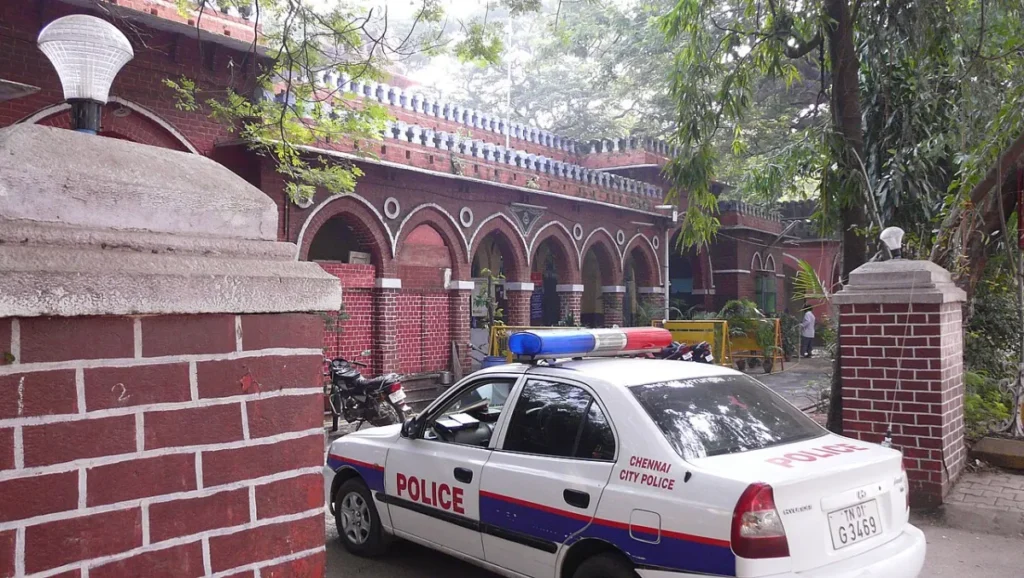
Do you really need tenant police verification before you hand over the keys? For most owners in Tamil Nadu, the honest answer is that it is a sensible safety step, and in some cities the police have at times ordered owners to share tenant details. Either way, tenant police verification takes little time once you know the route.
This guide explains what the check covers, which documents to collect, how to apply online through the Tamil Nadu Police citizen portal or at your local police station, how to handle your tenant’s consent and data, and what to do if something looks wrong. It is written for owners, but tenants will find a section for them too.
Table of Contents
Is tenant police verification compulsory in Tamil Nadu?
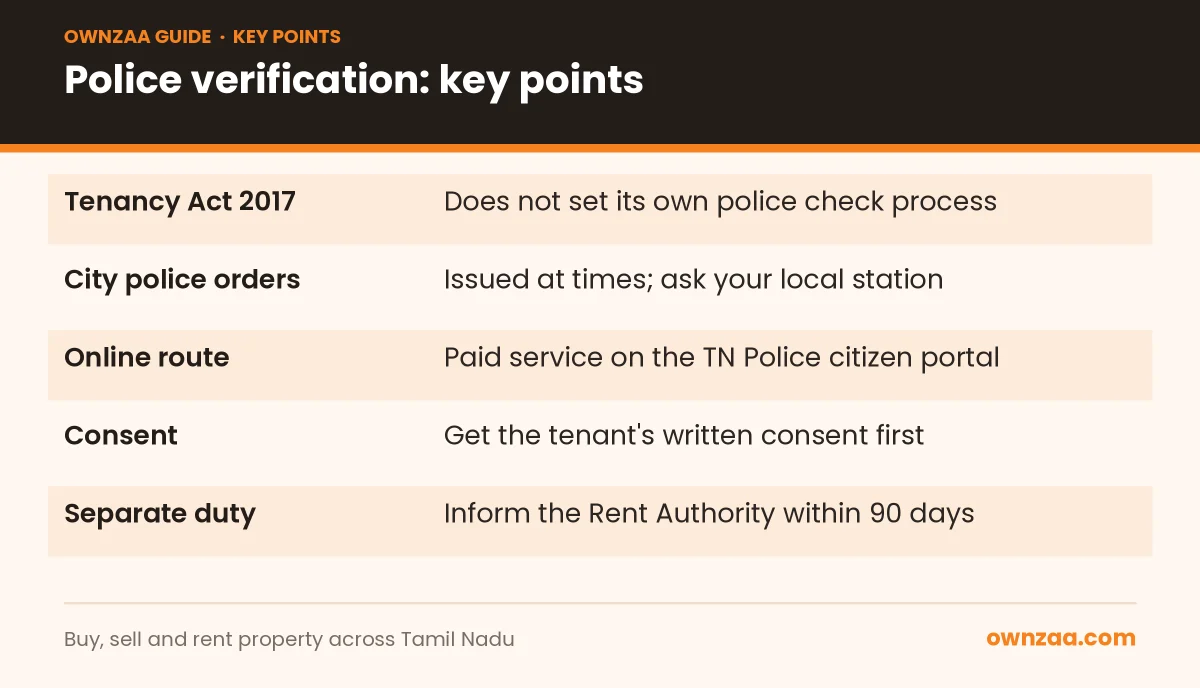
The main tenancy law, the Tamil Nadu Regulation of Rights and Responsibilities of Landlords and Tenants Act, 2017, deals with written agreements, deposits, rent and eviction. It does not set out a police verification process of its own.
Separately, city police have used their powers to issue orders asking owners to give tenant details to the local police station. Chennai police, for example, issued such an order in 2013 with a set tenant information format. Orders like these are issued for a period and may be renewed or replaced, so the position changes over time and from city to city.
The practical advice is simple. Ask your local police station whether an order is in force for your area right now. Even where it is not, completing police verification for tenants is a low-cost way to reduce risk and to show you acted carefully.
What police verification checks, and what it does not
Police verification is a check of the tenant’s identity and address against records the police can access. The local police station may also make enquiries at the address given. It helps you spot a false identity or a record the police already hold.
It does not tell you whether the tenant will pay rent on time, look after the house or get along with neighbours. It is not a credit check or a reference from a previous owner. Think of tenant police verification as one layer of safety, not the whole screening.
| Police verification can help with | It cannot tell you |
|---|---|
| Whether the ID and address look genuine | Whether rent will be paid on time |
| Records available to the police | How the tenant kept the last house |
| A formal record that you informed police | Job stability or income |
| Deterring people who give false details | Behaviour with neighbours |
For the other layers, such as references, employer checks and a short conversation, see our tenant screening checklist for Tamil Nadu landlords.
Why tenant police verification is worth the effort
Many owners in Tamil Nadu let a portion of the same building they live in. The tenant shares your gate, your terrace and sometimes your sump and staircase. Knowing who they are is about your family’s safety, not only your property.
Tenant police verification also works as a quiet filter. People who plan to use false names or hide from someone often back away the moment an owner mentions it. Genuine tenants, on the other hand, usually agree without fuss.
- It creates a record that you informed the police, which helps if anything goes wrong later.
- It shows neighbours and the apartment association that you rent responsibly.
- It gives you a reason to collect proper ID and a permanent address at the start.
- It makes it easier for the police to act quickly if there is ever an emergency at the house.
Apartment associations in many cities also keep their own tenant details form. That form is for the building’s records and is not a substitute for tenant police verification, so do both where they apply.
Details and documents to collect from your tenant
Collect these before you apply. Most of them you will need anyway for the rent agreement. Ask for them politely, and explain why you need each one.
| Item | Why it is needed | Tip |
|---|---|---|
| Recent passport-size photo | Identifies the tenant | A clear phone photo often works online |
| Photo ID | Confirms identity | Accept masked Aadhaar, voter ID, PAN or passport |
| Permanent address proof | Police check the home address | Should match the ID where possible |
| Previous rented address | Helps trace recent history | Ask for the old owner’s number too |
| Workplace or college details | Adds a second contact point | An office ID card copy is useful |
| Emergency contact | Needed in any crisis | A family member, not a flatmate |
| Signed rent agreement copy | Links the tenant to your house | Keep the tenancy start date handy |
For each adult who will live in the house, collect the same details. In a shared flat, that means every sharer, not only the person who signs the agreement.

How to apply for tenant police verification online
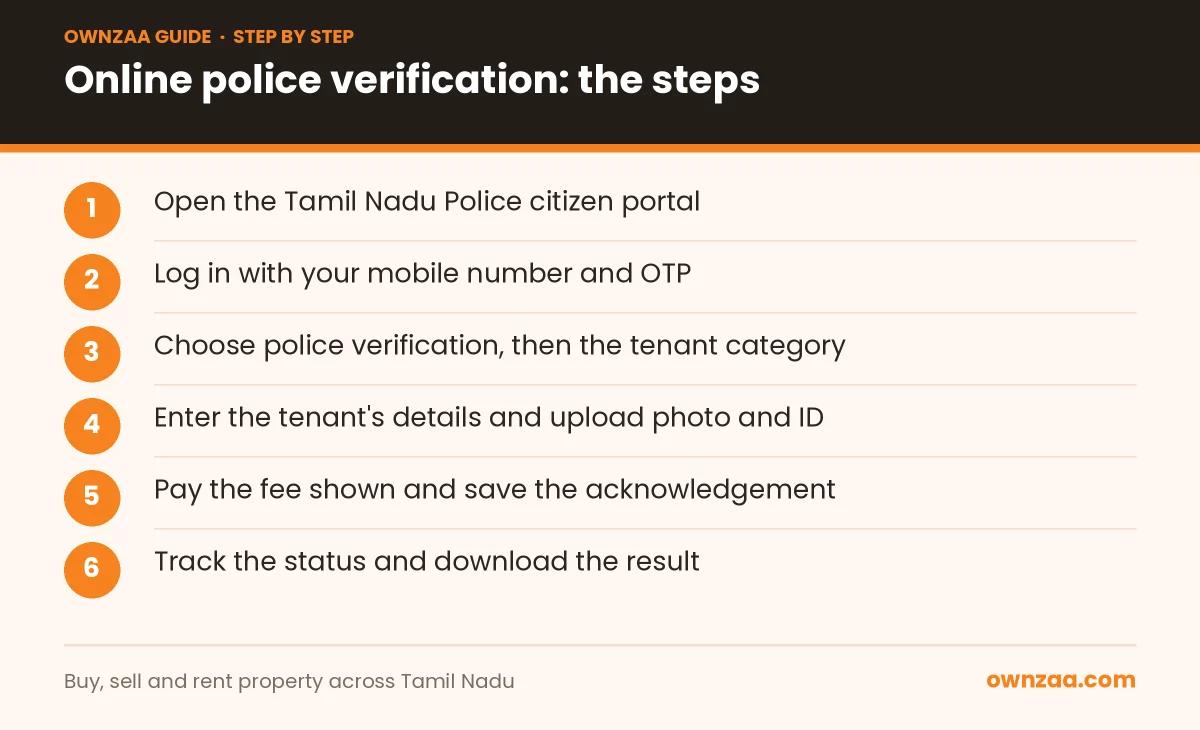
The Tamil Nadu Police citizen portal offers police verification services, including a tenant category. It is a paid service, and the fee is shown on the portal before you pay. Menu names change from time to time, so follow the on-screen instructions if they differ from the steps below.
- Open the Tamil Nadu Police citizen portal on a computer or phone.
- Register or log in with your mobile number and the OTP sent to it.
- Choose the police verification service and select the tenant category.
- Enter the tenant’s personal details, present address and permanent address carefully.
- Upload the photo and ID documents in the size and format the portal asks for.
- Pay the fee online and save the acknowledgement or application number.
- Track the status on the portal and download the result when it is ready.
The local police station handles the actual check, so the time taken varies with the station’s workload. Keep your phone reachable in case the station calls you or the tenant for clarification.
Applications usually get delayed for small, avoidable reasons. Check these before you submit:
- The tenant’s name is spelt differently on the ID and in the form.
- Uploaded photos or documents are blurred, cropped or too dark.
- The permanent address is incomplete, with no door number, street or PIN code.
- The tenant’s phone is switched off or not answered when the station calls.
The offline route: your local police station
If you are not comfortable online, you can complete tenant police verification at the police station that covers your property’s area. Ask at the front desk for the tenant information or verification form used there, fill it in, attach photocopies of the tenant’s photo and ID, and hand it over.
Always ask for an acknowledgement, such as a stamped copy or a receipt number. Without it, you have no proof that you informed the police. Keep this acknowledgement with your rent agreement file.
Some owners do both: they submit the online request and also introduce the tenant at the station. For a family moving into a portion house near the owner’s own home, a visit to the station can also help the local beat officer know who lives there.
Consent and data: protect your tenant’s privacy
Tenant police verification involves personal data, so handle it with care. Tell the tenant clearly that you will submit their details to the police, and get their written consent. A simple signed line in the agreement, or a separate note, is enough. A sample line is below; adjust it to your situation.
I agree that the owner may submit my name, photo, ID and address details to the Tamil Nadu Police for tenant police verification in connection with my tenancy at the address given in this agreement.
- Ask for masked Aadhaar, which UIDAI allows people to download with only the last four digits shown.
- Do not post ID copies in family or apartment WhatsApp groups.
- Store scans in one protected folder, not scattered across phones.
- Delete or return extra copies once the tenancy ends and dues are settled.
- Use the details only for verification and the tenancy, nothing else.
Treating your tenant’s data with respect builds trust from day one. It also protects you if a copy is ever misused by someone else.
When to do it: timing in the rental process
The best time for tenant police verification is after you choose the tenant and sign the agreement, but before or just after they move in. Starting tenant police verification too early wastes effort on people who may not take the house. Doing it months later defeats the purpose.
| Stage | What to do |
|---|---|
| Shortlisting | Meet the tenant, check ID and references |
| Agreement signing | Sign, collect documents and written consent |
| Move-in week | Apply for police verification online or offline |
| Within 90 days | Inform the Rent Authority on the tenancy portal |
| Any new occupant | Repeat verification for that person |
Police verification and Rent Authority registration are two different things. The Rent Authority step is required under the tenancy law, and the Rules set a 90-day window. Our guide on how to register a rent agreement with the Rent Authority explains that process.
Special cases: sharers, students and foreign nationals
Shared flats need tenant police verification for each adult occupant. If one sharer leaves and a new one joins, verify the new person as well. Police verification for tenants is about who actually lives in the house, not only whose name is on the agreement. Ask the main tenant to inform you before anyone new moves in; sub-letting needs your written consent under the Act anyway.
Students renting near colleges often give a hometown address and a parent’s number. Verify with those details and keep the college ID copy. For working professionals on transfer, an office ID and HR contact add confidence.
If your tenant is a foreign national, separate reporting rules apply to people who host foreigners. Ask the local police station or the Foreigners Regional Registration Office about the current requirement before the tenant moves in.
When you renew an agreement with the same tenant and the same occupants, a fresh check is usually not needed. Keep the earlier result in your file and update it only when someone new moves in. The portal’s verification service also covers categories such as domestic help, which is useful if you hire a caretaker for a rented building.

If the tenant refuses, or the result raises a concern
A genuine tenant rarely refuses verification when you explain it calmly. If someone refuses outright, gives different names on different documents, or pushes you to skip the agreement, treat that as a warning sign. It is usually better to wait for another tenant.
If the verification result raises a concern after the tenant has moved in, do not act on your own. Do not cut power or water, change the locks or throw out belongings; the Act does not allow these steps. Speak to the police station about the report, and consult an advocate about ending the tenancy through lawful means. Eviction in Tamil Nadu happens only through the Rent Court, on grounds listed in the Act. Our guide to rights under the Tamil Nadu Tenancy Act lists those grounds.
For tenants: what to expect and how to respond
As a tenant, expect a careful owner to ask for ID, a photo and consent for tenant police verification. This is normal and it protects you too. A house where the owner checks every occupant is usually a safer building to live in.
You can also ask the owner for their ID and proof that they own the house, or that they are authorised to let it. This helps you avoid fake listings and advance fraud, which our guide to common rental scams in Tamil Nadu covers in detail. When you search for a house to rent, owner-direct listings make these conversations easier. Share masked Aadhaar where possible, and ask how your documents will be stored.
If the police station calls you, answer the questions honestly and keep your ID handy. A delay in responding only delays your own verification.
Frequently asked questions
Is tenant police verification mandatory in Tamil Nadu?
The Tamil Nadu Tenancy Act does not itself lay down a police verification process. However, city police have at times issued orders requiring owners to share tenant details with the local police station. Ask your local station whether such an order applies to your area today. Even when it is not required, verification is a sensible safety step.
Who applies for police verification for tenants, the owner or the tenant?
Usually the owner applies, because the check is for the owner’s safety and the owner’s property. The tenant provides the details, documents and written consent. In some cases a property manager or family member applies on the owner’s behalf. Whoever applies should keep the acknowledgement number and share the result with the owner.
How long does tenant police verification take?
There is no single fixed time. The local police station carries out the check, so the time depends on its workload and on how quickly the owner and tenant respond to any calls. Apply during the move-in week, track the status on the portal, and follow up with the station if it seems stuck for a long time.
What does it cost?
Verification through the Tamil Nadu Police citizen portal is a paid service, and the fee for each category is shown on the portal before payment. Fees can change, so always check the current amount there. Submitting a tenant information form at your local police station may not involve a fee, but ask the station.
Can I rent to a tenant before verification is complete?
Many owners let the tenant move in once documents are collected and the request is submitted, because results can take time. That is a practical approach if everything else checks out, such as ID, references and the agreement. If anything feels wrong at the screening stage, wait for the result before handing over keys.
Does police verification for tenants replace Rent Authority registration?
No. They are separate steps with separate purposes. Tenant police verification is a safety check with the police. Informing the Rent Authority on the tenancy portal is a requirement under the Tamil Nadu tenancy law, and the Rules set a 90-day window for it. Do both, and keep the acknowledgement and registration number in your tenant file.
Next steps for owners
Make tenant police verification a fixed step in your renting routine, just like the agreement. Keep a simple tenant file for every tenancy: the signed agreement, ID copies, written consent, the police verification acknowledgement and the Rent Authority registration number. It takes ten minutes to set up and saves hours later.
For a complete owner’s routine, from fixing rent to handing over keys, see our landlord guide to renting out a house in Coimbatore; most of its steps apply anywhere in Tamil Nadu. When you are ready, post your property on OWNZAA for free and talk to tenants directly by call or WhatsApp, with no commission on the deal. Owners can also add a Verified badge by sharing ID and ownership proof, which helps careful tenants trust your listing.
This guide is general information, not legal or tax advice. Rules and fees change — confirm current details on the official portals linked above or with a qualified advocate/chartered accountant before you act. Information checked: September 2026.
Image credits: top photo — Triplicane Police Station (4147929314) by Ashwin Kumar from Bangalore, India, CC BY-SA 2.0, via Wikimedia Commons (resized); in-article photo — Kodambakkam view by L.vivian.richard, Public domain, via Wikimedia Commons (resized); infographics — OWNZAA.
Ready to find your next property?
Browse verified listings for sale and rent across South India, or post your own property — your first listing is free.